
For apparel decorators, growth has never looked more promising — and never more complex. Shopify stores, Etsy sellers, TikTok Shop merchants, white-label storefronts, and long-standing B2B clients now all feed into the same production floor. In theory, more channels should mean more opportunity. In practice, they’ve reshaped the very front end of the workflow: order intake.
The challenge isn’t printing capacity. It’s that modern demand is arriving in more formats, through more systems, with more variation than apparel workflows were ever built for. Before a single garment is printed, teams must reconcile a maze of incoming data, artwork requirements, product variations, and fulfilment expectations. That upstream work now determines how efficiently everything downstream can run.
Multi-channel expansion sounds like a go-to-market strategy. But for PSPs, it has become an operational shift — one that’s redefining how decorators handle every order that enters the shop.
The hidden cost of channel proliferation
Decorators once worked with a handful of predictable order pathways. Orders came through familiar systems, spoke the same data language, and moved through production with a steady rhythm.
As ecommerce diversified, that rhythm splintered.
-
Every storefront behaves differently.
-
Every integration speaks its own dialect.
-
Every platform expects its own fulfillment rules.
The result isn’t just more work, it’s messier work.
A Monday morning can begin with half a dozen dashboards open, artwork attached in inconsistent formats, and product data that doesn’t match any existing template. Teams spend their first hours making sense of data that should already be production-ready.
And the more channels a shop adds, the more this friction compounds.
Where multi-channel workflows break
The patterns are remarkably consistent across decorators of all sizes. As channels multiply, specific pressure points start to surface:
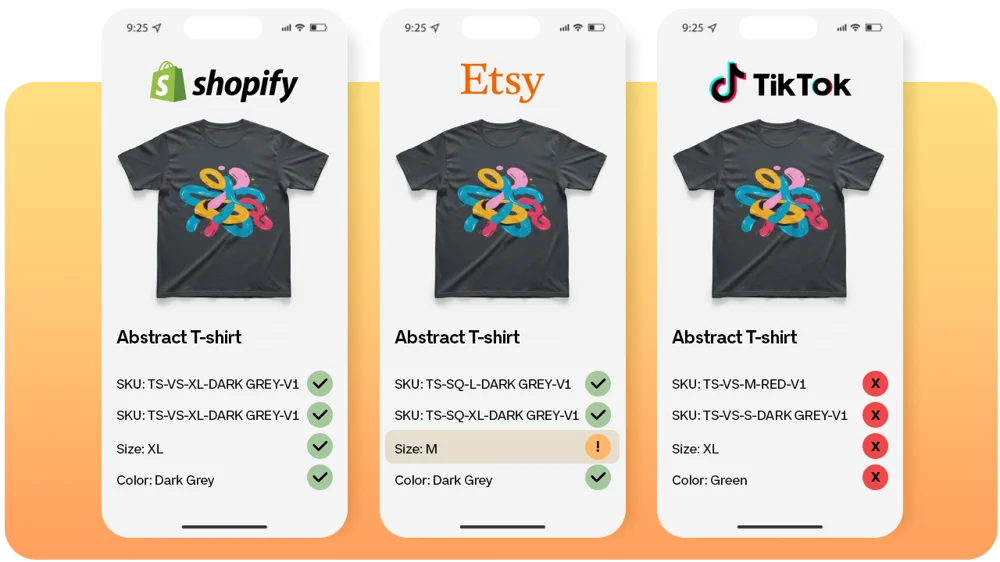
Data inconsistency: SKUs and attributes differ by platform, forcing teams to manually reconcile product information.
Artwork irregularity: Files arrive in formats that require intervention. One channel sends vectors, another sends PNGs, another relies on text notes.
Fragmented fulfilment rules: Platforms use different shipping expectations, labels, or packaging requirements.
Disjointed order sources: Orders live across dashboards, inboxes, custom APIs, and marketplaces, creating constant reconciliation overhead.
None of these challenges are new individually. But together (across five, seven, or ten channels) they create an environment where decorators spend more time preparing orders than producing them.
Apparel feels this more than any other category
Clothing carries more variables than most printed products: size, colour, fit, material, placement, personalisation, and decoration method. When order data is inconsistent, those variables multiply rather than stack.
It only takes a single mismatched attribute to derail an entire batch. One missing size can block the fulfilment of a bundle. One ambiguous artwork file can delay dozens of jobs behind it.
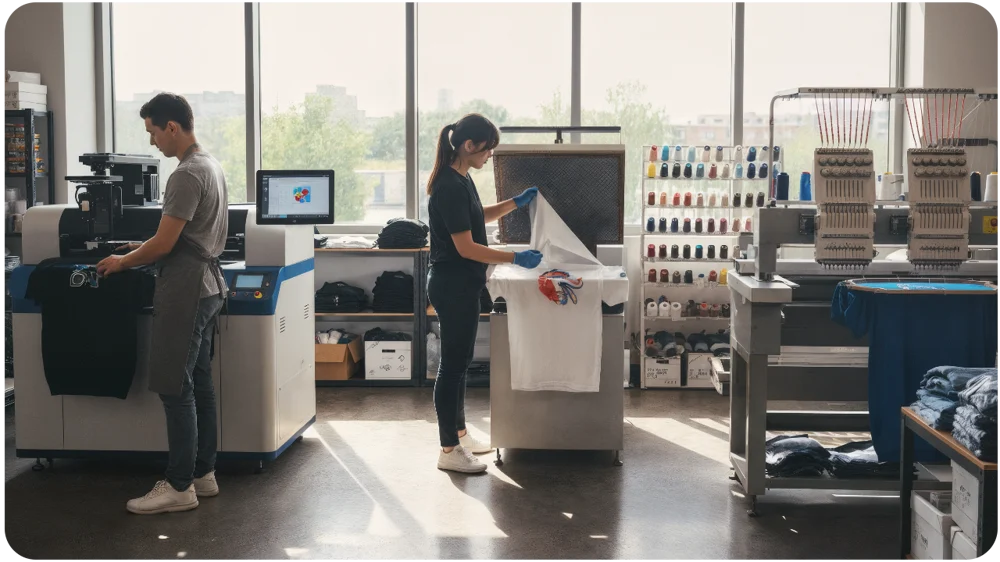
And because apparel often involves hybrid workflows (DTF for small runs, embroidery for premium SKUs, DTG for mid-volume complexity) routing decisions become more fragile as channels diversify.
It's not that decorators don't know how to handle complexity. It's that complexity is now coming at them from more angles, with less structure, and with higher expectations for accuracy.
The shops getting ahead have one thing in common
The decorators who have stayed sane, and scaled, in this multi-channel era didn't solve complexity with more people. They solved it by creating a different kind of order intake altogether.
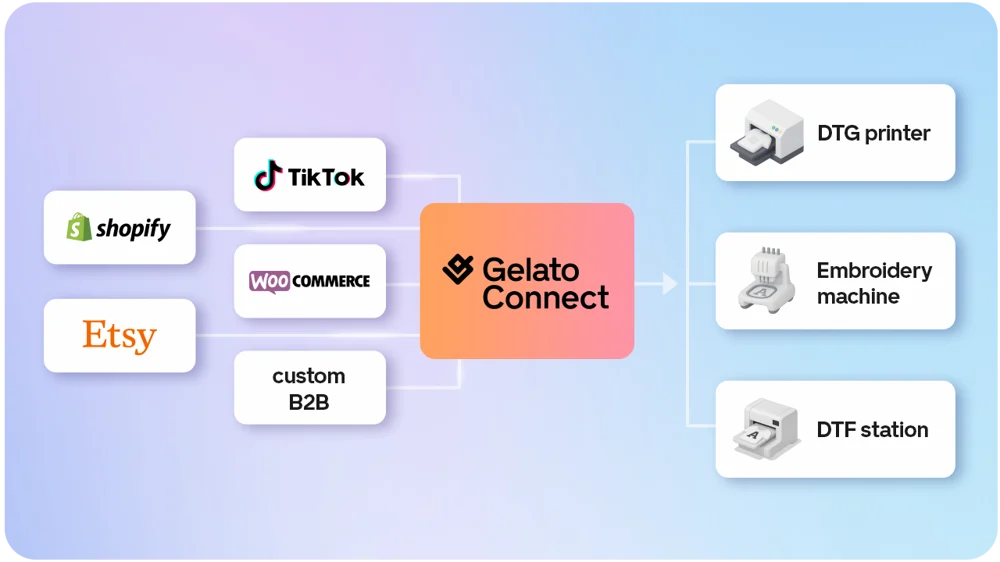
They treat channels not as individual sources of work but as contributors to a single operational core. Instead of stitching together dashboards, they centralize. Instead of fixing data manually, they normalise it. Instead of reacting to inconsistent artwork, they standardise the rules for what enters production.
The future of apparel requires better foundations
Decorators don’t struggle because they use too many platforms — they struggle because those platforms don’t speak the same language. When order intake is fragmented, every new channel adds strain. But when workflows are unified, channels stop being a source of chaos and become a source of scale. A shop can onboard new partners without reworking its processes, support multiple brands through a single flow, and grow volume without growing headcount.
Ecommerce will only continue to splinter into new platforms and buyer behaviours, which means multi-channel isn’t a trend — it’s the environment. As apparel enters another year of rapid marketplace-driven growth, now is the moment to assess whether your workflows are built for a single storefront or for the multi-channel reality that increasingly defines modern fulfillment. The decorators who thrive in 2026 will be the ones with foundations strong enough to handle all of it.
Speed is no longer an output of hard work. It's a reflection of how well a shop is designed to operate. And in today's market, that design is becoming the difference between decorators who keep up and decorators who lead.
Find out how you can keep ahead of the market with GelatoConnect specifically designed for Apparel decorators.


-3.webp?width=1024&height=1024&name=download%20(10)-3.webp)