When Connor Pera bought The Print Authority three years ago, he wasn't just buying a 34-year-old printing business. He was buying into a future he knew would look very different from today.
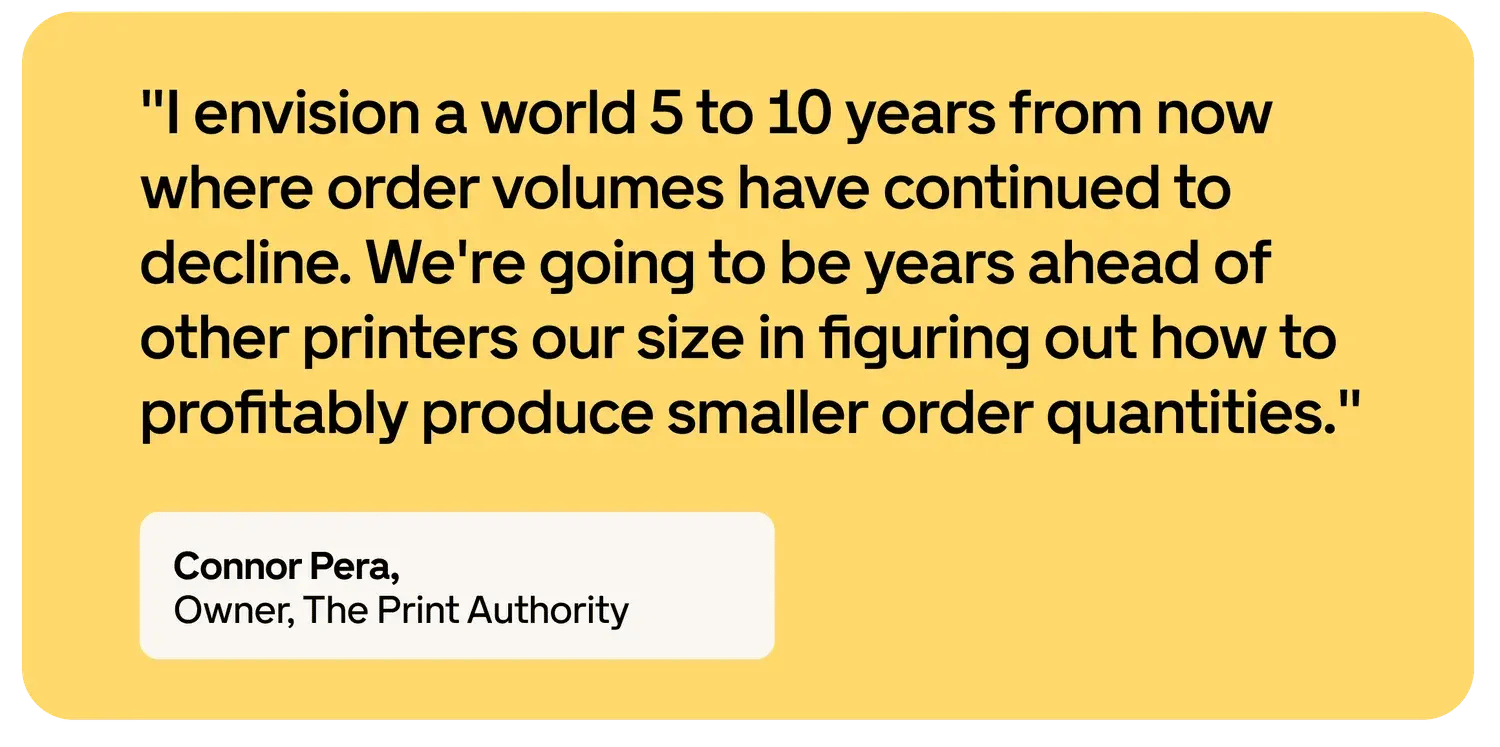
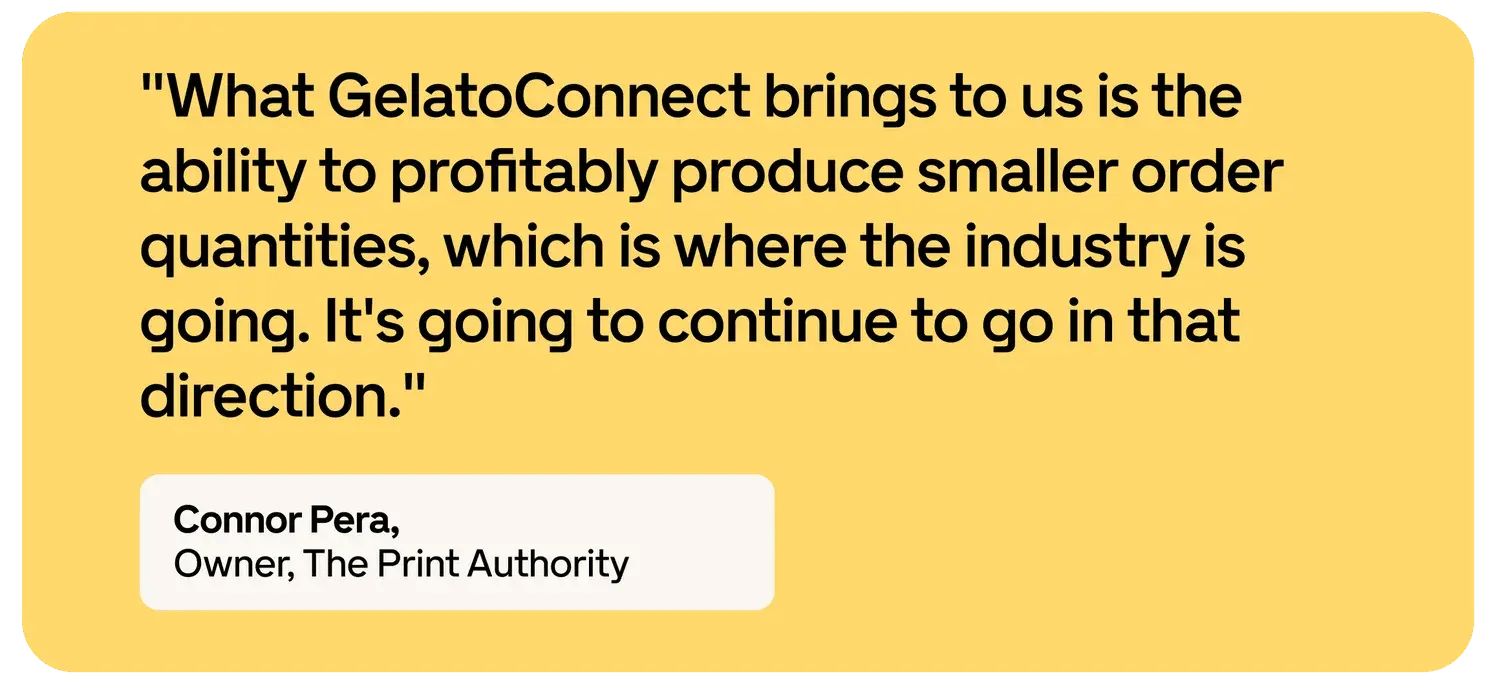
"I envision a world 5 to 10 years from now where order volumes have continued to decline," Connor explains. The trend is already clear across commercial printing: orders are getting smaller, quantities are shrinking, and the theoretical challenge looming for the industry is how to profitably produce one business card.
For The Print Authority, serving franchise customers and multi-location brands across the southeastern United States, this wasn't a hypothetical problem to solve later. It was a strategic reality to prepare for now.
The real cost of small orders
The operational math is straightforward but unforgiving. When order volumes decline but touch points stay the same, profitability erodes quickly.
Previously, every order at The Print Authority followed the same path regardless of size: web submission, manual job ticket creation, graphics department processing, file preparation, printing, finishing, shipping.
"It wasn't necessarily one extreme bottleneck," Connor says. "The big thing is the number of touches per order and an inability to really see in a very real-time way what is happening in the production facility."
Multiple disconnected systems (web-to-print platforms, MIS tools, shipping interfaces) each required manual work. Even web-based orders needed conversion before moving to production. Inventory lived in spreadsheets. Checking order status meant literally walking to the production floor.
This works fine when orders are large enough to absorb the labor cost of manual touches. It breaks down when order sizes shrink but operational overhead stays fixed.
Let technology run day-to-day operations
Connor's philosophy became the foundation for transformation: "The technology runs the day-to-day operations and the people run the technology. Let's get the technology to do that and free up the people to solve the problems, the true exception cases that need handholding, need more customer attention."
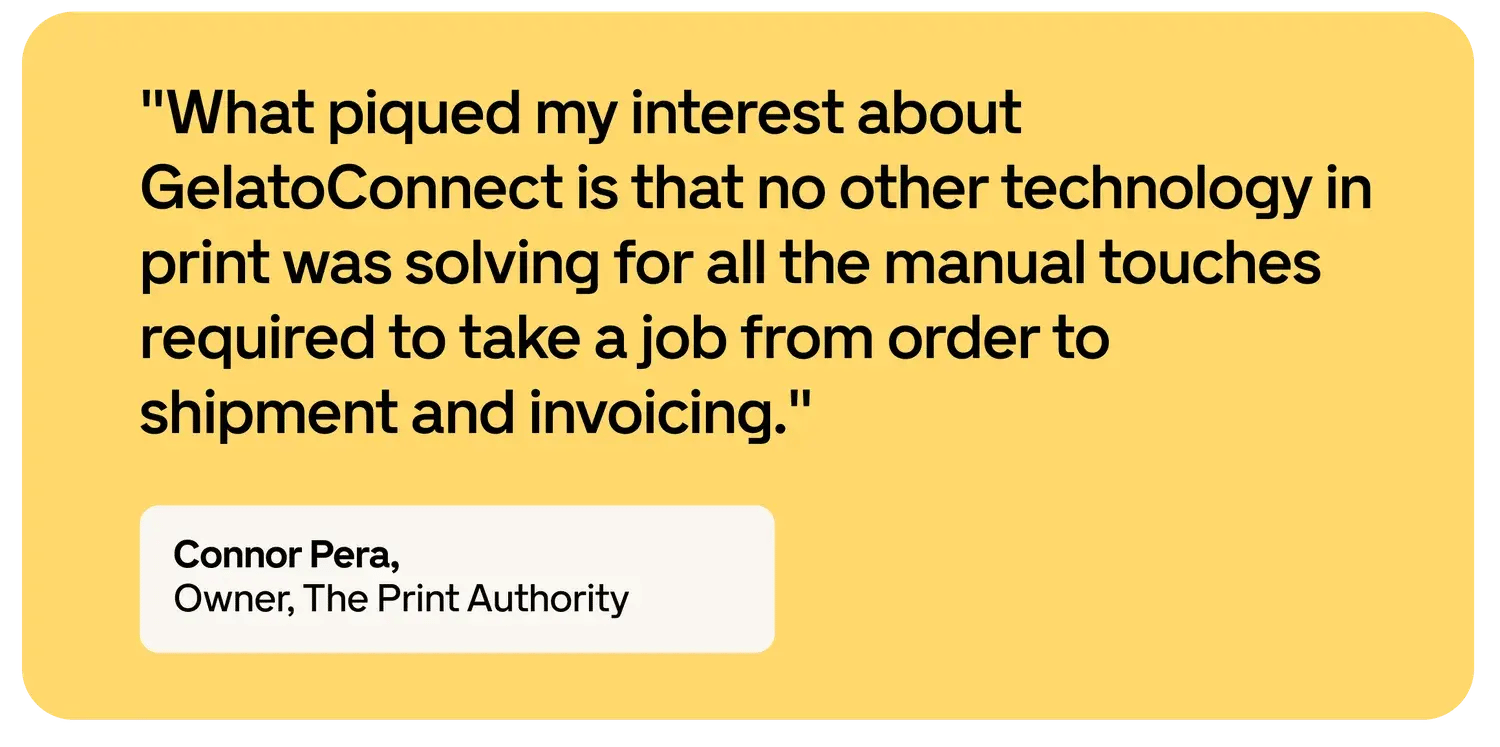
GelatoConnect became The Print Authority's intelligent infrastructure for executing this vision. The platform connects procurement, workflow, and logistics so straightforward orders (60-80% of volume) flow through automated routing, production, and fulfillment without manual intervention.
For promotional products, what previously required multiple manual steps now happens automatically. "We're building the workflow so that as soon as that order is received, that job is entered into production and simultaneously a PO is created and generated for us to just click a button to send to the vendor," Connor explains.
One order received. Two actions automated. Several touches eliminated.
"Once you get the workflows and the system set up, once the order is received, it's on the press, it's ready to be printed. That skips several manual touches."
This matters enormously when processing smaller orders. The labor cost per order drops dramatically when technology handles routing decisions, file preparation, and production scheduling without human intervention.
Freeing people to solve real problems
Automation doesn't replace judgment. It redirects it toward situations where human expertise actually drives value.
When 60-80% of orders flow through intelligent automation, experienced team members can focus attention on complex situations requiring customization, customer consultation, or problem-solving. Instead of spending time on routine data entry and system navigation, they handle exception cases that benefit from skilled attention.
For Connor as owner, this shift creates perhaps the most significant operational change: freedom from firefighting.
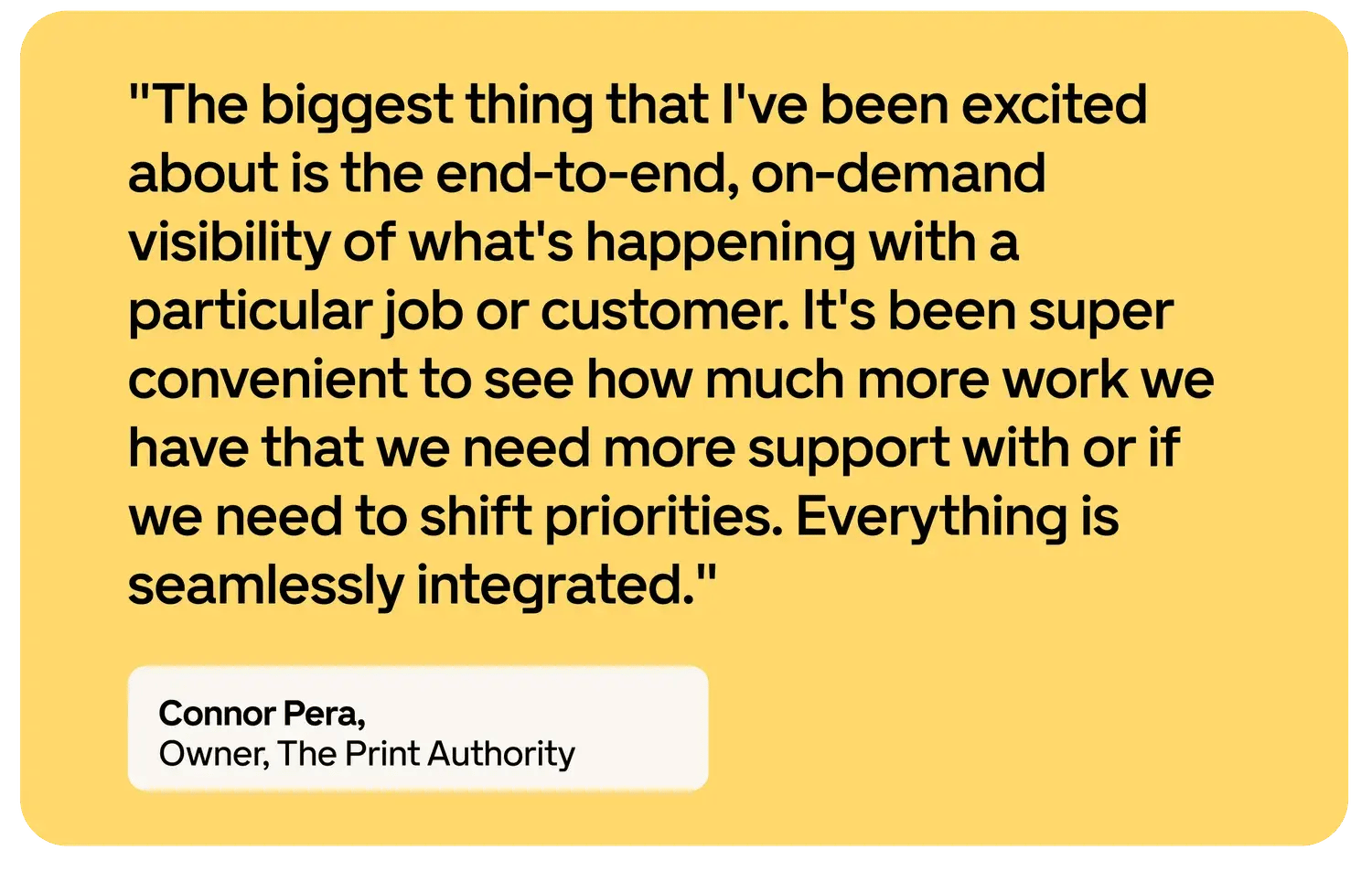
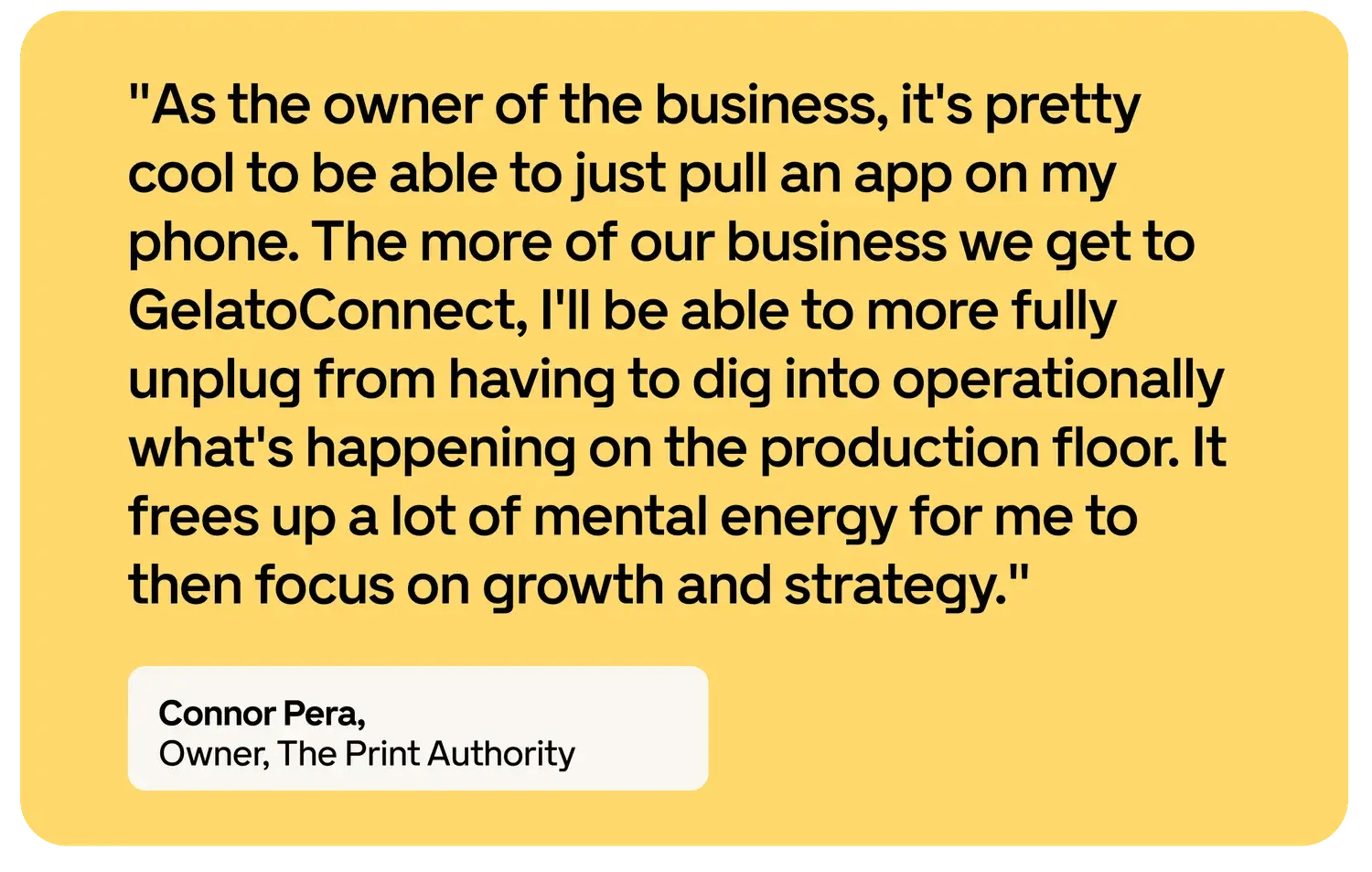
"As the owner of the business, it's pretty cool to be able to just pull an app on my phone," Connor says, describing how GelatoConnect's mobile app provides real-time visibility across customer orders, production status, inventory levels, and shipping.
Previously, understanding what was happening required being physically present or calling the production floor. Now, during busy periods especially, "it's been super convenient to be able to just see how much more work we have that we need more support with or we need to shift priorities to make sure things get completed. I can track what's happening in real time."
The visibility creates mental space for strategy instead of operational details. "The more of our business we get to GelatoConnect, I'll be able to more fully unplug from having to dig into operationally what's happening on the production floor."
That freedom represents time redirected toward growth planning, customer relationships, and positioning the business for the next decade instead of managing daily production logistics.
Intelligent batching for smaller quantities
The deeper operational capability came from Gelato's experience handling high volumes of small orders through their Create platform.
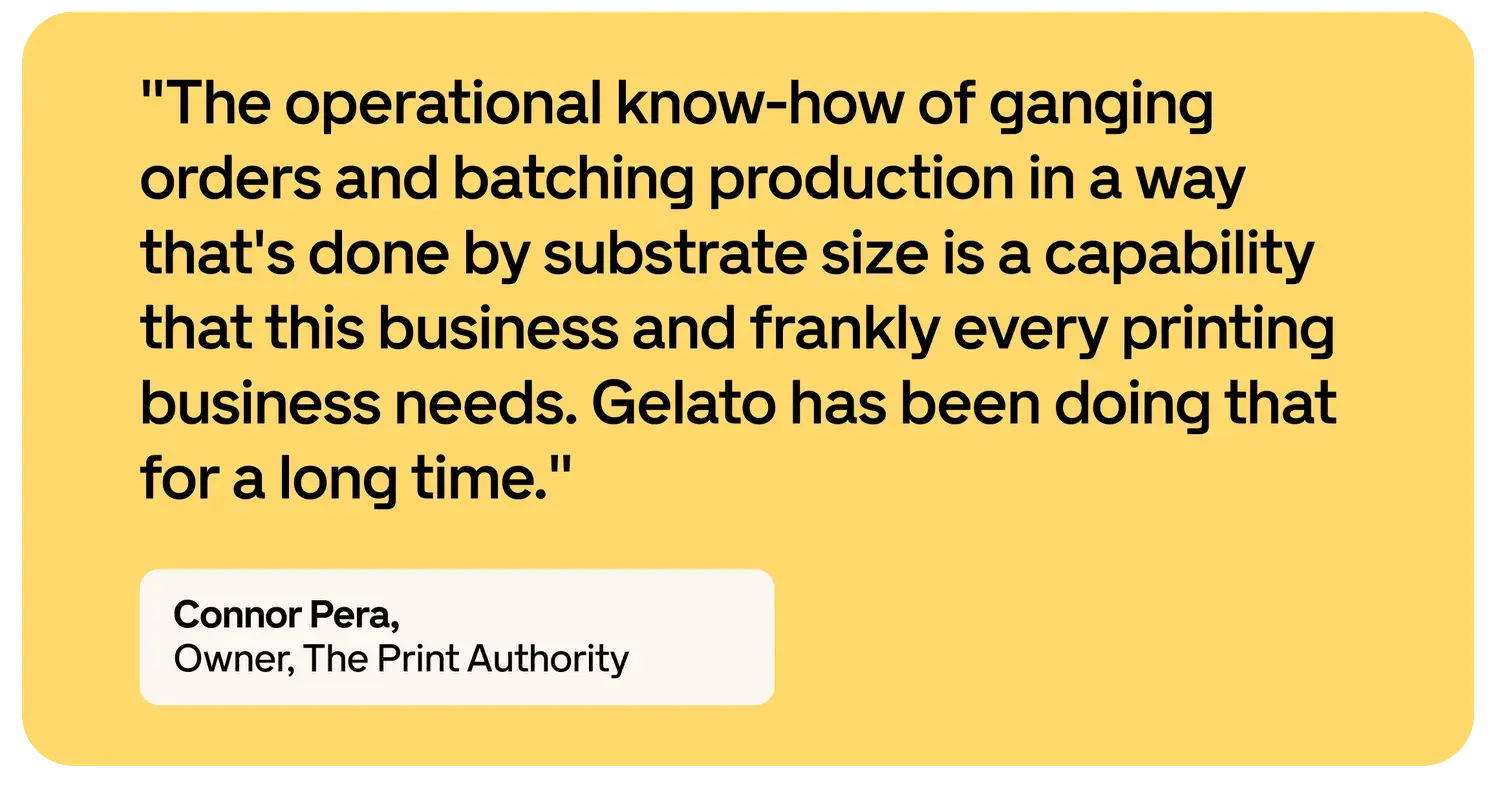
"Gelato has been doing that for a long time on the Create side," Connor notes. "The operational know-how of ganging orders and batching production in a way that's done by substrate size is a capability that this business and frankly every printing business needs."
When orders get smaller, profitability depends on intelligent batching. Aggregating multiple small orders based on substrate, size, and workflow requirements creates production efficiency that wouldn't exist processing each order individually.
This isn't just software automation. It's accumulated operational knowledge about how to profitably produce small quantities built into the system's logic.
"The way that Gelato thinks about production in a print environment is where the industry is going," Connor explains. GelatoConnect brings this approach to commercial printing operations, helping PSPs adapt to market realities before competitors recognize they need to change.
Building a five-year head start
The transformation delivered immediate operational benefits. Shipping costs dropped approximately 10% through GelatoConnect Logistics consolidating carrier options and leveraging Gelato's aggregated volume for better rates. New customers can be onboarded faster. New product categories can be added without rebuilding systems.
But Connor sees the intelligent infrastructure as more than efficiency gains. It's competitive positioning for an inevitable industry shift.
"The printers that don't adjust to that reality are still going to be able to survive and compete in today's market," Connor says, "but 5 to 10 years from now as we continue to play out the trends in the market, they're going to have to adjust really fast. Some of them will, but we by having a 5 to 10 year head start, we're going to be in a really good position to compete and win."
Printers who build capability now for profitably producing smaller order quantities will have significant operational advantages over those who wait until market pressure forces the change. By the time competitors realize they need intelligent batching, automated workflows, and consolidated systems, The Print Authority will already have years of operational learning built into their infrastructure.
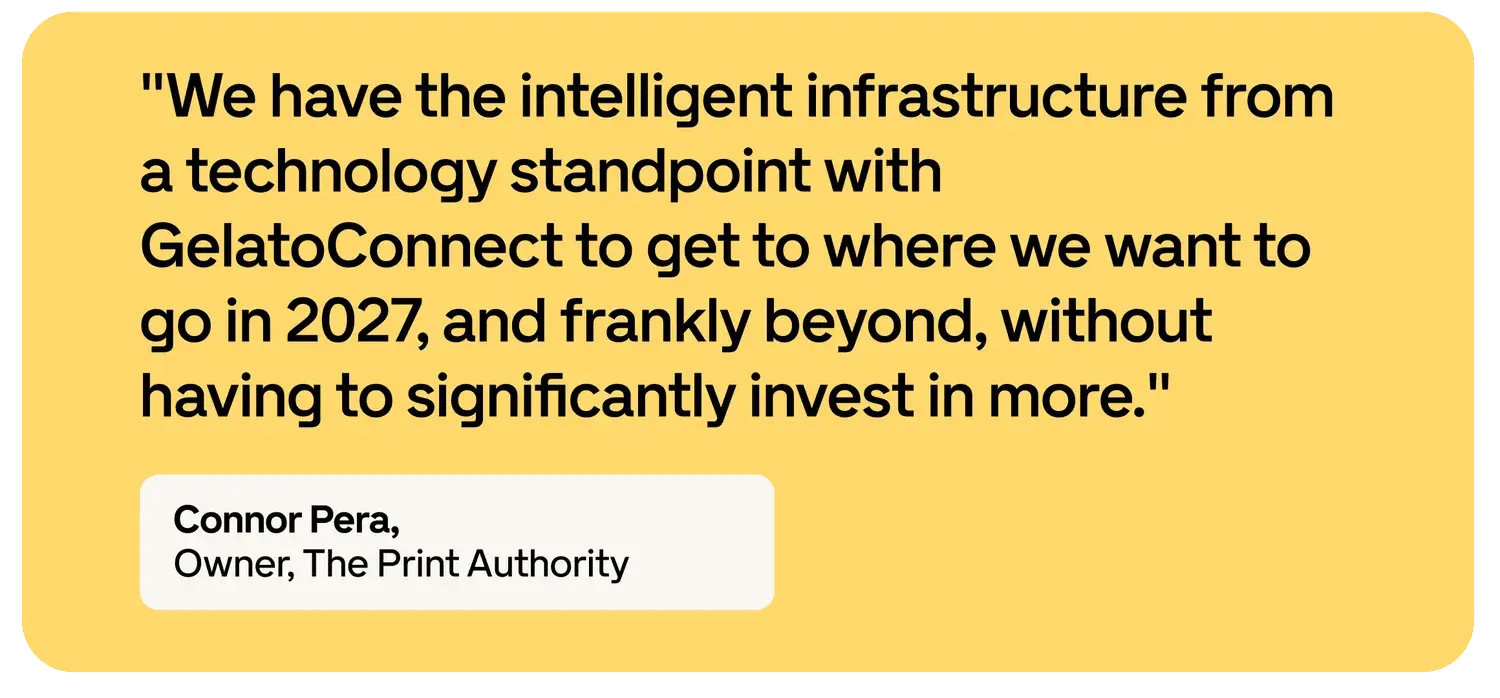
"We have the infrastructure today to get to where we want to go and frankly beyond," Connor explains. "We have the infrastructure from a technology standpoint with GelatoConnect without having to significantly invest in more infrastructure."
Ready for what's coming
The Print Authority is "midstream" in their GelatoConnect implementation, with some customer workflows fully automated and others still transitioning. But the strategic foundation is already in place.
As order volumes continue declining and quantities keep shrinking, The Print Authority has intelligent infrastructure that handles routine operations automatically, experienced team members focused on situations requiring judgment, and an owner who can think strategically instead of managing production logistics.
The technology runs day-to-day operations. The people solve real problems. And the business is positioned 5-10 years ahead of competitors who haven't yet adapted to where the industry is heading.
Connor's advice reflects hard-won perspective: "Growth just means additional investment in technology and tools and people." The question isn't whether the print industry will shift to smaller order volumes. It's whether your infrastructure will be ready when it does.
Ready to transform your print operations?
Fill in the form below to request a demo of GelatoConnect and AI Estimator with the GelatoConnect team.

.png?width=1024&height=1024&name=Customer%20Inkee%20-%201280x720px%20(1).png)