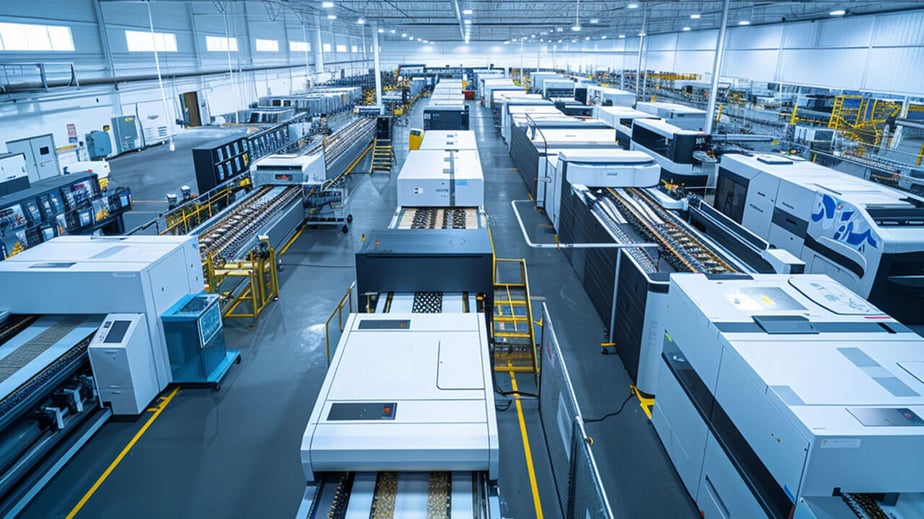
Print production is a fascinating arena, encompassing several stages from initial design to the final printed output. It's an art that demands precision, technological sophistication, and essential skills.
This in-depth guide illuminates the entire process, exploring everything from different printing techniques to digital technology's roles in today's modern printing domain.
Whether you are new to the industry or an experienced professional looking for a refresher, this guide is a must-read for you.
What’s new in print production in 2026
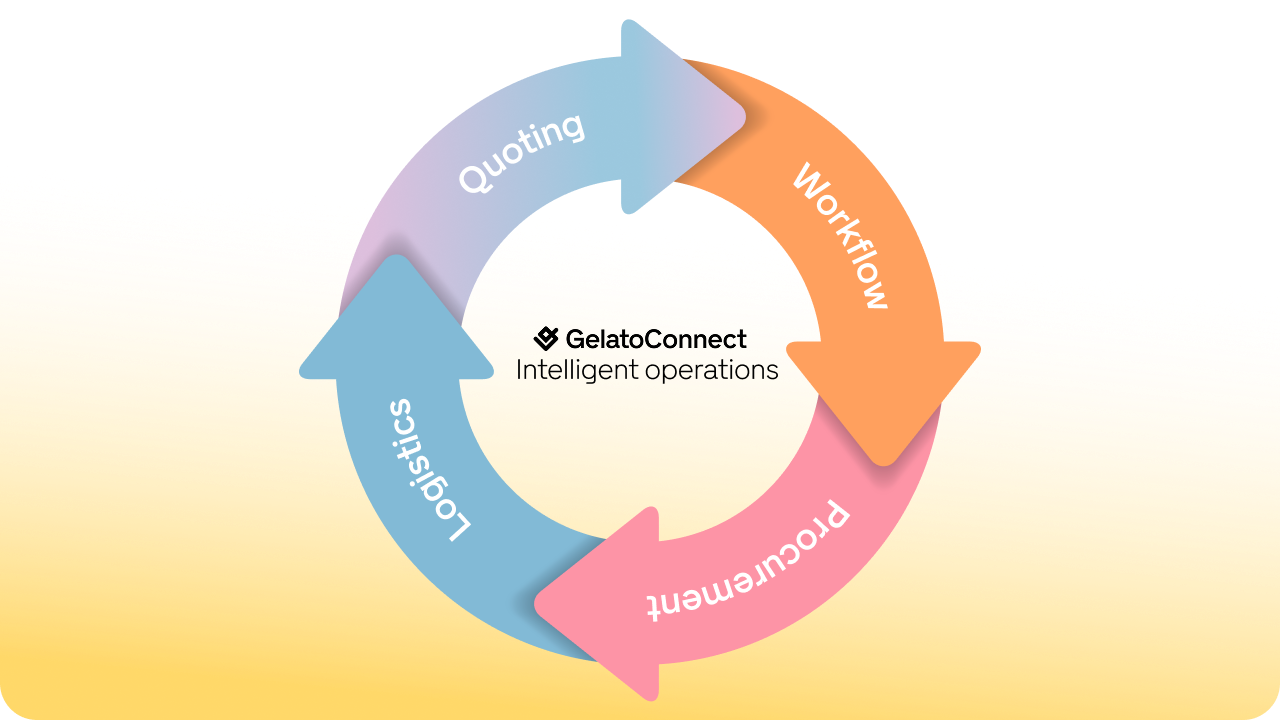
The fundamentals of print production have not changed in 2026. What has changed is how the stages connect. Mid-sized print service providers running on a unified production platform now operate at error rates below 0.35 percent (versus the 1.5 percent industry baseline), achieve 98 percent on-time dispatch (versus the 81 percent industry average), and improve operating margin by 3 to 7 percentage points within the first 12 months. The shift is structural: a single data spine across quoting, procurement, production, and shipping replaces the legacy MIS plus point-tool stack that defined print operations for the last decade.
This guide covers the seven stages of modern print production, what intelligent print production looks like in practice, and how AI is reshaping each stage.
Main takeaways from this article:
-
Understand the comprehensive workflows with printing production, i.e., the nature of print production, from initial design to final output.
-
Discover the diverse techniques employed in creating printed materials, including the increasing relevance of digital technology.
-
Understand the three stages of print: Pre-press, production, and the post-press process to create better workflows at your print shop.
-
Gain knowledge about environmental considerations and the integration of sustainable practices in print production to create better workflows with print.
-
Discover solutions to common print production challenges and ways to expand your skill set in the industry.
What is print production?
It is the process of creating printed materials from digital or analog layouts through various methods such as offset, digital, or screen printing. The overall print job involves steps like prepress, printing, and finishing and is crucial for producing books, magazines, brochures, and other printed media.
Understanding the stages of print production
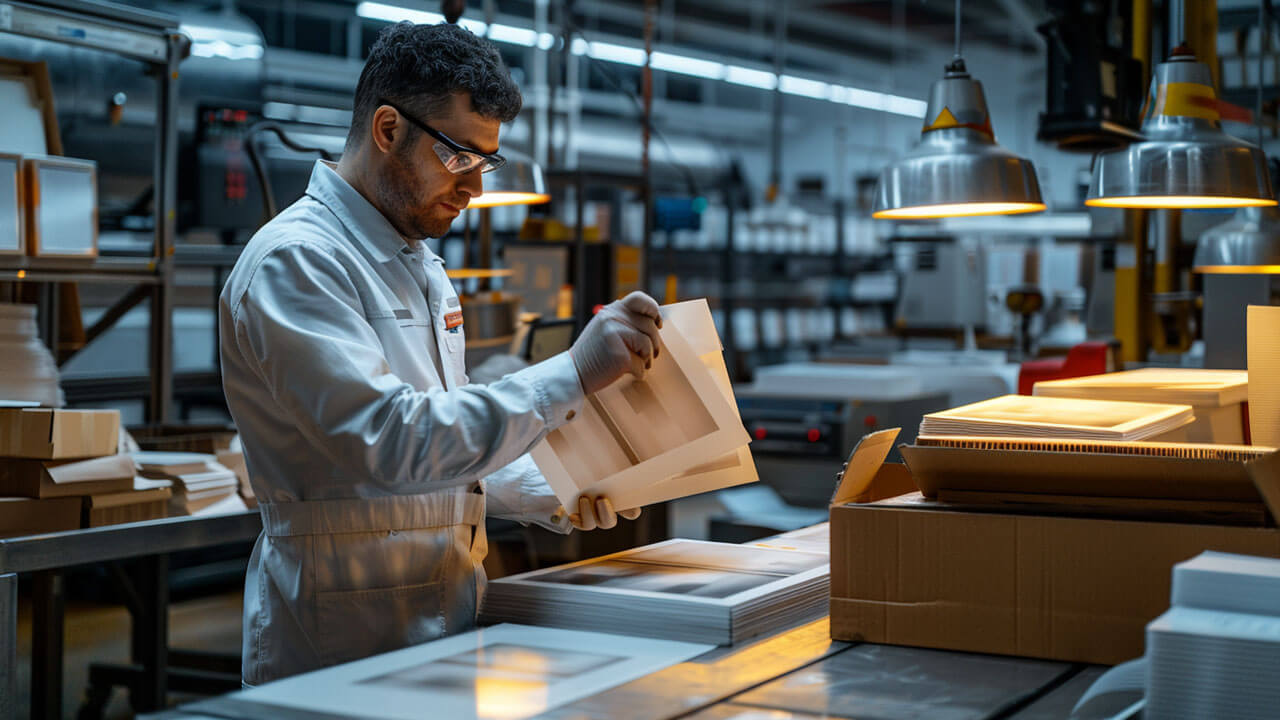
Now that you know what print production is, let's peel back the layers of creating printed materials through this printing process. Let's uncover each stage, from initial concepts to the tangible end product, learning about pre-production, production, and post-production.
1. Pre-production
The digital print production journey begins with pre-production, and this is where all the groundwork is laid - from brainstorming and refining your design concept to preparing the necessary materials. Think of it as the blueprint stage, without which the actual production couldn’t efficiently proceed.
Let's understand the printing process steps that this phase involves:
-
Conceptualization: This is the initial phase where teams brainstorm ideas. It involves problem identification, conceiving a communication strategy, and drafting preliminary designs. Creativity plays a pivotal role here.
-
Design creation: Once you finalize the idea, graphic designers use software like Adobe Illustrator and Photoshop to create the design. They decide on elements like typeface, color scheme, and layout.
-
Artwork review: Review the artwork for errors or changes after creation. This step is essential to ensure the final product meets the initial vision and specifications.
-
Use of 3D printing: In specific projects, you may use 3D printing, be it for promotional marketing freebies, novelty items, or toy figurines. The use of 3D printed models can help visualize the final product better.
Preliminary proofing: Before the project moves into production, you prepare a preliminary proof, usually a virtual or physical representation of the final product, allowing for final adjustments.
2. Production
Regarding the production stage of print manufacturing, several methods can come into play. They can range from traditional techniques, such as flexography and relief printing, to modern digital and 3D printing practices. Each technique has unique benefits and intricacies, making it imperative to choose the method that best fits your project needs and the message you are trying to communicate.
This stage involves:
-
Flexography: A printing technique commonly used for high-volume runs. It works well on various substrates and is especially effective for packaging, labels, newspapers, and catalogs.
-
Relief printmaking: An age-old method in which you carve the image into a surface and ink the protruding area for printing. This technique delivers stunning artistic effects.
-
Digital printing: A method well-suited to small, custom jobs due to its short setup time and cost-effectiveness. It's perfect for jobs that require high levels of customization.
-
Screen printing: Ideal for printing on fabric and t-shirts, screen printing is a versatile, valuable technique for producing signage and other promotional items.
-
3D printing: A revolutionary technology that creates physical objects from digital designs, giving creators unmatched flexibility in bringing their digital designs to life.
-
Hand papermaking: This technique involves working with artists to create unique and editioned work. It's a specialized skill infusing handmade elements into print production.
-
Woodblock printing: One of the oldest printing methods, it uses hand-carved wooden blocks to create textiles and traditional art prints.
Post-production
Once the press has worked its magic, we've entered the post-production phase of commercial print production – an equally pivotal part of the print production process. The post-press stage focuses on whether the leftover ink washes away and the paper remains trimmed, meticulously inspecting each piece for misprints or imperfections.
Post-production is the final check and balance to ensure the end product meets, if not exceeds, quality expectations. It involves:
-
Quality assurance: The post-production phase involves rigorous quality checks to ensure the final product meets the desired standards. These checks can use visual inspections, digital proofs, and more.
-
Packaging and distribution: After finalizing the print, specialists must carefully package and distribute it. The appropriate packaging is paramount for safe delivery, whether we're talking about catalogs, magazines, brochures, or books.
-
Feedback collection: Engaging post-press and collecting feedback is essential in this phase. It helps producers improve their offerings in subsequent prints and add value.
-
Inventory management: Proper inventory management of printed items is vital for efficiency and cost management. Keeping track of stock and what needs reprinting enables effective planning.
-
Sustainability practices: This is where the emphasis on sustainability practices comes into play. During this phase, we manage waste from the production process, recycle and reuse resources wherever possible, and calculate the ecological footprint of the production process.
-
Data recording: The post-production phase also involves recording for future order fulfillment and audits. By keeping up-to-date records, companies can more effectively manage supply and demand.
Key components of effective print production

Understanding the critical components of effective print production involves familiarizing yourself with the necessary equipment, software, and roles within the sector. These aspects play a crucial part in executing a flawless print production procedure.
Here's what they entail:
-
Essential equipment: Printing production relies on several critical pieces of equipment, including high-speed, high-quality printing machines for bulk orders, pad printing for decorative prints, screen printing, offset printing tools for smooth finishes, and flexography equipment for package prints. Advanced digital printing tools leverage laser and inkjet technologies, while traditional techniques may use lithographic and woodblock printing tools.
-
Indispensable software: Print production requires modern software solutions beyond physical equipment. These can range from graphic design software to layout and formatting tools. Further, print production management software, like GelatoConnect, helps coordinate and automate various aspects of the production process, effectively increasing efficiency and securing supreme print quality.
-
Skills and roles: Various roles are integral to print production, including graphic designers who create visually pleasing designs and prepress technicians who prepare those designs for the final print. Production managers oversee the process, ensuring timelines and quality standards are complied with. Other roles, such as quality control inspectors, print machine operators, and post-production specialists, are vital to smooth printing production processes.
Integrating sustainability into the print production process

As with every other industry, print production is responsible for enhancing sustainable practices. Incentivizing profitability and ecological consciousness is not just morally idealistic but is increasingly becoming an essential business strategy.
Let's discuss some of these environmentally friendly strategies that you can incorporate into your print production process:
Using environmentally-conscious inks
Many traditional items in the printing industry contain volatile organic compounds (VOCs), which contribute to air pollution and can even pose health hazards. But did you know certain types of ink are less harmful?
Vegetable or soy-based inks, for instance, carry significantly lower levels of VOCs. For example, Cornell University's bioengineered soy-based ink can help decrease VOC emissions compared to petroleum-based inks, contributing to a healthier working environment and reducing air pollution.
Choosing sustainable paper
Responsibility in print production also extends to the type of paper used. Papers produced from responsibly managed forests ensure a sustainable cycle of paper production.
For example, the Forest Stewardship Council (FSC) certifies such sustainable paper, ensuring the paper comes from a responsibly managed forest. Alternatively, you can also opt for recycled paper, reducing demand for fresh paper and consequently slowing down rampant deforestation.
Minimizing waste
Streamlining print production processes reduces paper waste and increases efficiency, which can involve incorporating digital proofing technologies that catch mistakes before they land on paper, batch processing tasks to avoid overproduction, and implementing resource-efficient printing techniques like duplex printing.
Incorporating energy-efficient technologies
It's interesting to note that digital printing technology boosts productivity and has significant ecological advantages. It consumes less energy than traditional print methods and produces less waste.
For instance, HP's Indigo Digital Presses uses a unique process that eliminates the need for make-ready sheets, thus resulting in less paper waste and energy usage. In this way, advancing technology and sustainability work in the print production industry.
The State of Intelligent Print Production 2026
Benchmarks, trends and AI strategies from the world's leading print operations — see what's driving growth in 2026.
Download the report →Utilizing green packaging
Adding a finishing touch to your print production process could be implemented by adhering to green packaging practices. Opt for packaging material that is recyclable, reusable, or compostable.
A prime example is IKEA's decision to use mycelium or mushroom packaging, which is 100% biodegradable. Although this may require an initial investment, being a 'green company' furthers your brand reputation amongst increasingly eco-conscious customers.
How to navigate common print production challenges
Navigating the challenges of print production is a crucial step toward successful print runs. This process can be complex, but you can simplify it by knowing how to overcome common issues.
Let's look at some of these challenges and possible solutions:
-
Handling file formats: Stick to universally accepted formats such as PDF. Ensure you correctly convert your designs into these formats before sending them to print.
-
Mismatched colors: Calibration between design software and printer is crucial. Tools such as color-match cards can ensure the output matches the original design.
-
Upholding print quality: Regular maintenance of machines, using high-quality raw materials, and frequent print tests can help consistently deliver high-quality prints.
-
Keeping costs low: Some strategies to keep costs at bay are ordering prints in bulk, optimizing designs cost-effectively, and evaluating various vendors for the best rates.
-
Meeting deadlines: Planning, maintaining an organized workflow, and having backup plans can help in meeting project deadlines.
-
Avoiding errors in the final print: Always proofread and review designs multiple times before hitting the print button. Team members should also be involved in the revision process to catch errors.
-
Managing waste: Incorporating sustainability into the print production process, choosing eco-friendly materials, and reducing print waste are essential considerations.
Free demo
Still managing print production with spreadsheets and disconnected tools?
See how GelatoConnect replaces 5+ systems with one connected platform — from order intake to dispatch.
Book a free demoPrint production software: the tools modern PSPs rely on
Modern print production depends on software as much as it does on presses. The right tools connect every stage — from order intake and prepress to scheduling, imposition, and shipping — so nothing falls through the cracks.
The core categories of print production software include:
- Management Information Systems (MIS) — Job tracking, quoting, invoicing, and production scheduling. Legacy options like Tharstern, Pace, and PrintIQ are common, but newer AI-native platforms are replacing them with more connected, automated workflows.
- Prepress and workflow automation — Tools that handle file preflight, colour management, imposition, and proofing. Workflow automation reduces human touchpoints, catches errors before they reach the press, and speeds turnaround.
- Procurement and inventory management — Software that automates supplier sourcing, purchase orders, and stock replenishment. Automated procurement eliminates manual stocktakes, prevents stockouts, and can reduce material costs by 5–20%.
- Shipping and logistics platforms — Multi-carrier selection, label generation, address validation, and real-time tracking. The best platforms compare rates across 100+ carriers in seconds to cut shipping costs.
- Web-to-print portals — B2B and B2C storefronts that let customers place orders, personalise templates, and approve proofs without manual intervention.
The trend across the industry is clear: standalone, siloed tools are giving way to connected platforms that manage the entire production lifecycle in one place. This reduces data re-entry, eliminates version-control mistakes, and gives operators a single dashboard view from order to dispatch.
How AI is transforming print production
Artificial intelligence is reshaping print production in ways that go far beyond buzzword territory. Here are the areas where AI delivers measurable impact today:
Intelligent quoting and estimation
Manual quoting — pulling up spreadsheets, checking substrate prices, calculating setup costs — is one of the biggest bottlenecks in print. AI-powered estimating software can generate accurate quotes in seconds instead of hours. It learns from historical job data, material costs, and margin targets to produce prices that are both competitive and profitable. Print service providers using AI estimation report win-rate improvements of up to 300% simply because they respond faster.
Production scheduling and batching
AI-driven scheduling analyses press capacity, substrate compatibility, and delivery deadlines to group jobs into optimal batches. This minimises changeovers, reduces waste, and maximises throughput — particularly important as print runs shrink and job counts rise.
Quality control and defect detection
Computer vision systems can now inspect printed output in real time, catching colour drift, registration errors, and substrate defects before an entire run is wasted. Combined with inline colour measurement, AI quality control brings production error rates below 0.35%.
Predictive logistics
AI carrier-selection algorithms compare delivery speed, cost, and reliability across dozens of carriers for every shipment. The result: up to 40% lower shipping costs and 98% on-time dispatch rates.
Print production workflow automation: from order to dispatch
A well-automated print production workflow follows a clear path. Here is what a modern, connected production line looks like step by step:
- Order intake — Orders arrive automatically from web-to-print portals, ecommerce channels (Shopify, Etsy, Amazon), email, or API integrations. No manual re-keying.
- Prepress automation — Files are preflighted, normalised, and imposed automatically. Proofs are generated and sent for approval without operator intervention.
- Job scheduling — The system batches compatible jobs, assigns them to the most suitable press, and builds the daily production schedule.
- Production — Operator-guided workflows display job instructions on-screen. Press integration pulls data directly from the system, reducing setup errors.
- Quality checks — Inline inspection and measurement catch defects immediately, triggering reprints before dispatching faulty products.
- Finishing and packaging — Cut, fold, bind, and package. Automated label generation and address validation ensure parcels are correctly labelled first time.
- Shipping — AI carrier selection picks the best option per parcel. Tracking data flows back to the customer in real time.
The goal is near-touchless production — minimising the points where a human must intervene — so that the same team can handle significantly more volume without adding headcount. Customers using connected platforms report 25–100% growth without extra hiring.
Automate print production with GelatoConnect
GelatoConnect is the intelligent operating system for digital print production. It replaces fragmented tools with one connected platform that automates procurement, optimises logistics across 100+ carriers, and connects every step from order intake to dispatch.
Here is what GelatoConnect delivers for print production teams:
- Procurement automation — Just-in-time ordering with automated supplier sourcing reduces material costs by 5–20% and eliminates manual stocktakes.
- Intelligent quoting — The AI Estimator generates accurate quotes in 15 seconds, replacing hours of spreadsheet work.
- Workflow automation — Operator-guided workflows and press integration create near-touchless production from order intake to dispatch.
- Shipping optimisation — AI carrier selection across 100+ global carriers cuts shipping costs by up to 40%.
- Apparel production — GelatoConnect Apparel manages DTG, DTF, and embroidery workflows with ecommerce channel integration.
The results are measurable: ESP Colour doubled profit margins and grew 20% without adding staff. Ink n Art saved EUR 700K annually and lifted EBITDA from 3% to 13%. Bennett Graphics cut material waste from 41% to 10%.
Book a free demo to see how GelatoConnect can transform your print production.
Ready to modernise your print production?
GelatoConnect customers report 3–7 point EBIT margin increases, up to 40% lower shipping costs, and 25–100% revenue growth without extra hiring.
Join ESP Colour, Ink n Art, Bennett Graphics and 100+ print producers already on the platform.
Book a free demo →Print production FAQs
How does digital printing differ from traditional offset printing in print production?
Digital printing and offset printing are two primary methods used in print production, each with distinct advantages. Digital printing is ideal for lower-quantity orders and when you need a quick turnaround. It allows for greater flexibility in terms of customization, as each print can be different.
On the other hand, offset printing is more cost-effective for large volumes and provides superior color accuracy and quality. This method uses plates to transfer images onto paper and is highly efficient once the initial setup is complete.
What are the key factors to consider when selecting paper for a print production project?
Choosing the right paper is crucial in print production as it impacts the final quality and effectiveness of the printed material. Here are some key factors to consider:
-
Weight and thickness: Heavier and thicker papers are typically perceived as higher quality but are more expensive.
-
Finish: Options include glossy, matte, and uncoated finishes, each providing a different aesthetic and tactile experience.
-
Brightness: The brightness of the paper affects the vividness and contrast of the printed colors.
-
Recycled content: For environmentally conscious projects, consider using paper with high recycled content.
What role does color management play in print production?
Color management is essential in print production to ensure that the colors in the final product match the designer's intentions and are consistent across different batches.
It involves adjusting the settings on various devices like scanners, monitors, and printers to achieve uniform color reproduction.
Proper color management helps avoid color discrepancies and ensures that the final output meets the expected quality standards, which is especially important in branding and marketing materials where color consistency is key.
What is the print production process from start to finish?
The print production process spans three main phases. Pre-production covers design, prepress, proofing, and file preparation. Production is where the actual printing happens — using digital, offset, screen, or flexographic methods depending on the job. Post-production includes finishing (cutting, binding, laminating), quality inspection, packaging, and shipping. Modern print producers automate as many of these steps as possible to reduce errors, speed turnaround, and lower costs.
What does a print production workflow look like in 2026?
A modern print production workflow is largely automated. Orders arrive from web-to-print portals or ecommerce channels and are preflighted, imposed, and scheduled without manual intervention. Jobs are batched by substrate and press, operators follow on-screen instructions, and inline quality inspection catches defects in real time. Shipping labels are generated automatically with AI-driven carrier selection. The result is near-touchless production that lets the same team handle significantly more volume.
What software do print producers use for production management?
Print producers rely on several software categories: Management Information Systems (MIS) for job tracking and invoicing, prepress tools for file preparation and colour management, procurement software for supplier sourcing and inventory, and logistics platforms for shipping. Increasingly, print service providers are replacing standalone tools with connected platforms like GelatoConnect that unify all these functions in one system — eliminating data silos and reducing manual work.