-3.webp?width=924&name=download%20(10)-3.webp)
The apparel industry is entering a decisive transformation. By 2026, the amount of unsold inventory a business carries will be one of the clearest indicators of operational inefficiency. Producers who learn to eliminate waste will be the ones positioned to win new partnerships, meet rising expectations, and protect their margins, while those who remain dependent on forecasting and bulk inventory will increasingly find themselves on the back foot.
Deadstock is a rising profitability risk for apparel producers
For decades, PSPs bought blanks in bulk to secure lower unit costs and shield themselves from demand volatility. But as ecommerce accelerated, that buffer turned into a strain.
Today’s shopper expects immediacy. According to the 2025 E-Commerce Trends Report, 81 percent abandon their cart if their preferred delivery option isn’t available. That pressure moves quickly upstream: shorter production cycles, faster fulfillment expectations, and less tolerance for delay.
Still, many PSPs continue to sit on weeks of idle inventory—capital that’s frozen at the exact moment agility matters most. Unsold apparel across the industry now sits near 30 percent, tying up working capital, absorbing warehouse space, and eroding margin.
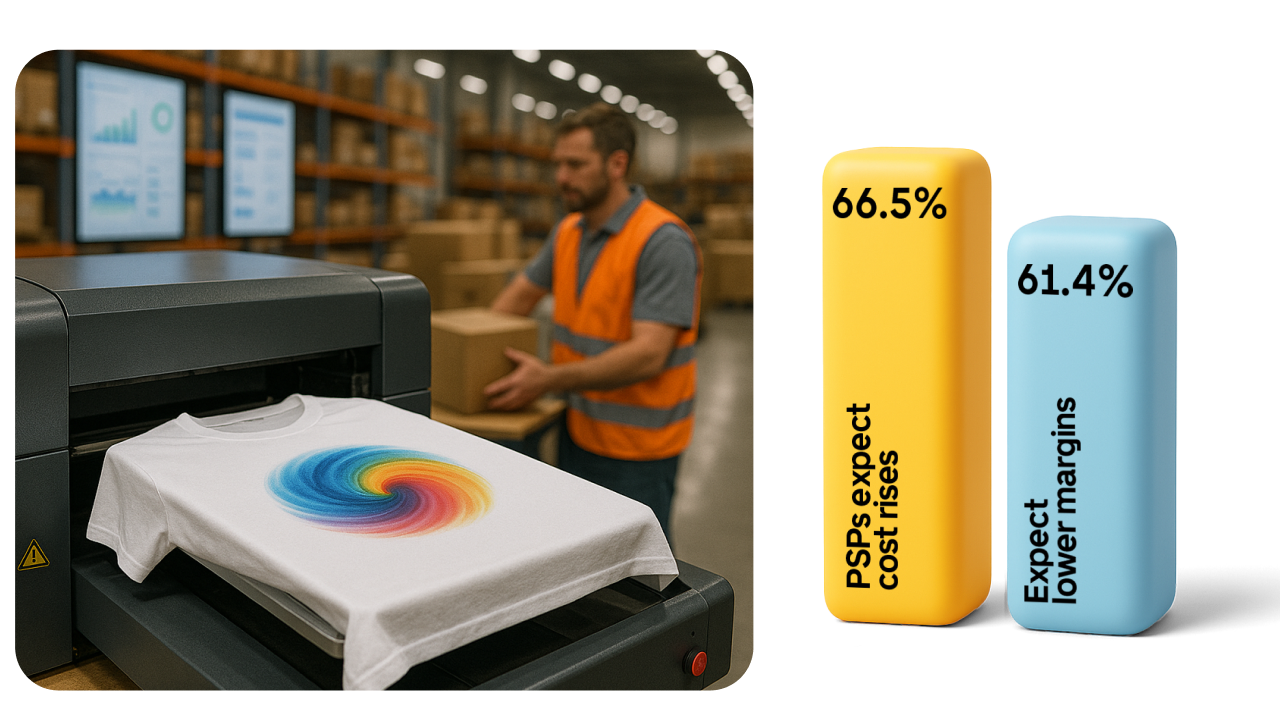
The financial backdrop only heightens this exposure. The GelatoConnect Peak Survey 2025 found that 66.5 percent of PSPs expect tariffs to raise operating costs, and 61.4 percent anticipate margin pressure in 2026. Under these conditions, deadstock becomes a structural threat, not an operational inconvenience.
Forecasting can’t keep up with today’s apparel demand cycles
Forecasting accuracy in fashion has fallen dramatically. McKinsey’s State of Fashion research shows accuracy dropping from roughly 70 percent a decade ago to just 50–60 percent today. For apparel producers managing hundreds of SKUs across sizes and colors, that gap translates directly into overproduction and excess stock.
Demand now shifts at the speed of a social feed. A single creator-led drop can spike interest in one SKU overnight while leaving others untouched. Traditional planning models, built around historical data, can’t react fast enough—and the difference lands on warehouse shelves.
The shift underway is not about forecasting better; it’s about relying on it less.
On-demand apparel production is becoming the new baseline
By 2025, 76 percent of retailers were already selling across three or more platforms. Consumers discover a product on TikTok, personalize it on Shopify, and expect it within days. They don’t see channels—they see immediacy.
On-demand production meets this reality. When storefronts, inventory, scheduling, procurement, and logistics operate within a single system, PSPs can produce with precision rather than prediction. A single personalized item can move through production with the same reliability as a larger batch. Working capital that once sat dormant in shelves of blanks can instead fund automation, expansion, or new product lines.
This shift is evident in the Outlook’s spotlight on TidyMerch. By connecting storefront activity to production decisions through GelatoConnect, they replaced manual reordering with automatic replenishment and gained real-time visibility across their operation. Rather than guessing what to purchase next, they began responding directly to actual demand.

Why zero deadstock is emerging as a competitive advantage
The most forward-looking PSPs aren’t treating zero deadstock as a sustainability initiative—they’re treating it as a business model. Eliminating excess unlocks agility, margin, and capacity. It enables more accurate purchasing, smoother production flow, and tighter order-to-ship cycles.
The Zero Deadstock 2026 Outlook highlights five strategic behaviors among PSPs making the fastest progress: building workflow visibility, automating where waste accumulates, standardizing production processes, leveraging networked capacity, and using real-time data to correct issues before they compound.
The common thread is responsiveness. Waste is reduced not through guesswork or restraint, but through systems designed to act only when demand exists.

What will shape apparel production in 2026
The report identifies five trends expected to redefine apparel production in 2026—from the normalization of zero deadstock, to the rise of AI-driven, self-adjusting workflows, to the shift from owning capacity to accessing it through global networks. Sustainability metrics will become measurable at the order level, and creator-driven brands will continue to influence the speed and variety of demand.
Across all five forces, the message is consistent: the most successful PSPs will be the ones who waste the least.
Get the full Zero Deadstock 2026 Outlook
This blog captures only a portion of the insights from the Zero Deadstock 2026 Outlook. The full report explores the economics, the operational shifts, and the real examples of PSPs modernizing their workflows today.