The apparel printing industry faces a fundamental shift in how production operates. For decades, businesses predicted demand, stockpiled inventory, and absorbed the costs of unsold goods through markdowns and waste. This forecast-driven model worked when consumer behavior followed predictable seasonal patterns. Today, with trends shifting hourly across social platforms and e-commerce channels, that approach has become a profit liability.
According to McKinsey's State of Fashion Report, approximately 30 percent of manufactured apparel never sells, representing billions in trapped capital and environmental waste. Meanwhile, the 2025 E-Commerce Trends Report reveals that 81 percent of consumers abandon their carts when preferred delivery options aren't available, and 76 percent of retailers now operate across three or more sales channels.
Economic pressures compound these challenges. Two-thirds of print service providers expect rising operational costs in 2026 due to tariffs and energy prices. The solution emerging across the industry replaces speculation with precision: producing only what sells, when it sells, through automated systems that eliminate excess while accelerating fulfillment.
This comprehensive guide explores how on-demand production powered by intelligent workflow automation is redefining profitability in apparel decoration, why traditional inventory models are collapsing under market volatility, and what practical strategies print businesses can implement to maximize efficiency and margins.
The True Cost of Excess Inventory
Modern shoppers demand immediacy. That expectation reverberates through the entire supply chain, requiring faster turnaround, smaller batch sizes, and unprecedented product flexibility. Yet many apparel decorators operate with weeks of idle inventory, creating significant cash flow constraints and competitive disadvantages.
Understanding the Financial Impact
The economics of excess inventory are unforgiving. Every unsold blank garment ties up working capital and consumes valuable warehouse space. Consider a mid-sized print service provider maintaining 10,000 blank units at $8 each. That's $80,000 in frozen capital. With industry-standard waste rates of 30 percent, this represents $24,000 in annual losses before accounting for warehousing, handling, or markdown expenses.
Rising operational costs intensify this pressure. Recent industry surveys show 66.5 percent of PSPs anticipate tariff-driven cost increases, while 61.4 percent expect margin compression. Combined with escalating energy and labor expenses, excess inventory transforms from manageable inefficiency to existential threat.
When Volume Discounts Become Liabilities
The traditional strategy of bulk purchasing to secure lower unit prices has inverted. With digital print technology enabling economical single-unit production and customers ordering in micro-batches, economies of scale have yielded to economies of precision.
Fashion demand forecasting accuracy has plummeted to approximately 50 percent from 70 percent a decade earlier, highlighting accelerating market unpredictability. For decorators managing hundreds of SKUs across multiple garment types, colors, and sizes, this margin of error translates directly into dead inventory. A forecast projecting 1,000 units might generate 400 units of unsold stock while simultaneously creating stockouts on trending items the model failed to predict.
Brand Reputation and Sustainability
Excess inventory carries reputational consequences. With 85 percent of e-commerce businesses positioning sustainability as core to their strategy, overproduction signals operational inefficiency. For both B2B buyers and end consumers, sustainability increasingly equals operational excellence. Warehouses full of unsold blanks communicate waste rather than preparedness, contradicting the brand image modern apparel companies seek to project.
Why Forecast-Based Planning Is Failing
Apparel demand now fluctuates daily, driven by social media trends that move faster than traditional production cycles. A single influencer post can spike demand for one design overnight while rendering last month's bestseller obsolete. Yet many producers continue planning next week's purchases using last quarter's data, a lag that proves increasingly expensive.
The Persistence of Manual Methods
Forecasting dominates most apparel production operations not because it delivers results, but because it's familiar. Despite data and automation reshaping adjacent industries, many producers still rely on institutional knowledge: predict demand, order in bulk, hope inventory sells. In markets driven by real-time orders and social commerce volatility, this reflex has become the industry's costliest habit.
For decorators managing diverse SKU portfolios across multiple garment categories, forecast inaccuracy translates directly to excess inventory problems. Projections calling for 1,000 units might yield 400 units of deadstock alongside simultaneous stockouts on items demand modeling missed entirely.
Hidden Labor Costs
Many print-on-demand providers manage procurement, printing, and shipping through disconnected systems. Orders arrive from Shopify or Etsy, transfer to spreadsheets, and trigger bulk reorders based on safety stock assumptions. This creates lag between customer purchase and inventory replenishment, generating both overstock and shortage situations simultaneously.
Labor costs alone prove substantial. PSPs using manual forecasting report spending 12 to 18 hours weekly on inventory planning, order consolidation, and supplier coordination. For production managers earning $65,000 annually, this represents $18,000 to $27,000 in labor dedicated purely to demand speculation. Automated workflow systems reduce this to 2-3 hours weekly, primarily for exception handling and strategic review.
When procurement, production scheduling, and fulfillment operate in separate systems, information requires multiple manual entries, creating error opportunities at every handoff. One European PSP documented 47 manual touchpoints per order before automation, each representing potential delays, mistakes, or inventory duplication.
The Response Time Gap
Lag between trend emergence and production response amplifies these challenges. Traditional PSPs operating on forecast-driven procurement require 14 to 21 days responding to demand signals. By then, viral trends have peaked, micro-influencers have moved forward, and revenue windows have closed. Connected PSPs operating on confirmed orders respond in 24 to 48 hours, capturing revenue while competitors update spreadsheets.
 The Shift to Order-Triggered Production
Across the apparel industry, a fundamental transformation is underway. What began as small-scale print-on-demand experiments has evolved into a comprehensive growth engine defined by responsiveness, creativity, and connectivity.
In 2025, 76 percent of retailers reported operating through three or more online platforms, with apparel leading this multichannel expansion. From Shopify to Etsy to TikTok Shop, creators design, market, and sell directly to audiences expecting next-day personalization. Each storefront depends on fulfillment that's flexible, fast, and sustainable.
Redefining Economies of Scale
For producers, this shift proves liberating. Modern workflows process single personalized hoodies as efficiently as 500-unit runs. Hybrid PSPs operating DTG, DTF, and embroidery on connected platforms demonstrate that automation rather than bulk defines profitability. By linking procurement, production, and logistics through integrated management software, they eliminate idle time and achieve utilization previously reserved for mass manufacturing.
For creators and brands, order-triggered production unlocks unlimited catalog potential. Every design exists as virtual inventory until purchase confirmation. For PSPs, this replaces warehouse capital with recurring revenue from distributed client networks. Together, these dynamics redefine scale: network intelligence now outperforms physical footprint.
Technology Infrastructure Enabling the Shift
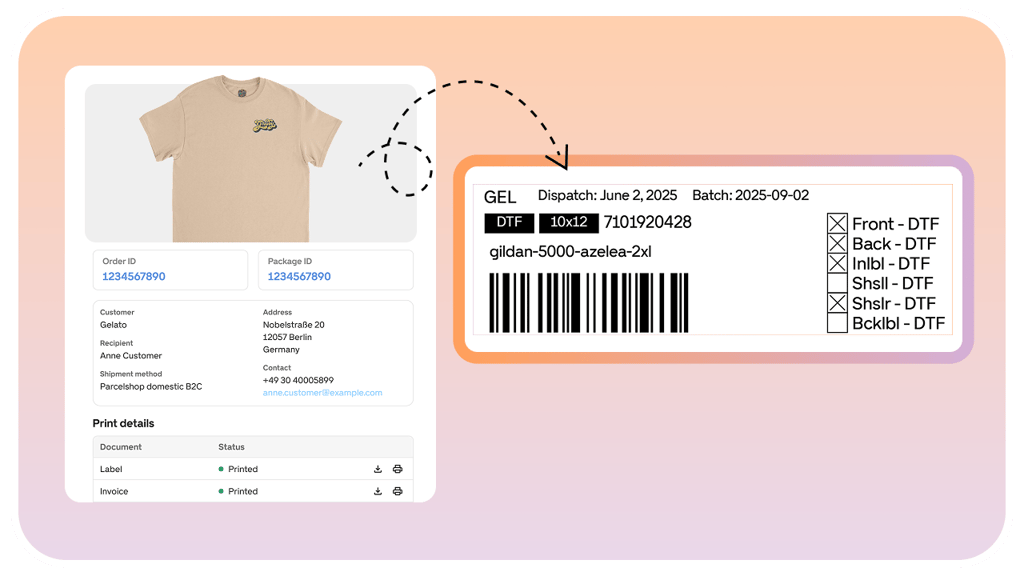
Intelligent systems integrate ecommerce storefronts, procurement, production, and logistics into continuous digital workflows. Orders automatically trigger sourcing, batching, and shipping without human intervention. Operations previously requiring five systems and three teams now run through unified platforms.
Economically, this model compounds its advantages. Working capital previously frozen in blanks now funds automation and expansion. Localized fulfillment reduces shipping costs and delivery times by up to 25 percent, while automated carrier selection and predictive procurement transform logistics from cost center to profit driver.
Five Strategies for Inventory Optimization
Successful inventory optimization isn't aspirational, it's systematic. Apparel decorators achieving excellence don't merely reduce waste; they engineer it out of their business models. The following strategies demonstrate how connected production systems convert efficiency into profitability.
Strategy 1: Establish Complete Visibility
Map every operational step from order intake to dispatch, measuring where time and capital disappear. Early implementations reveal 15 to 20 percent of labor time lost to manual tracking and rework. Real-time dashboards and AI-powered alerts convert blind spots into control points, enabling proactive rather than reactive management.
Strategy 2: Automate Critical Pain Points
Begin where waste hits hardest: procurement and fulfillment. Automation routinely delivers 20 percent material cost reductions and 25 percent shipping cost savings.
T-Shirt Gang, an apparel fulfillment company serving thousands of micro-brands, automated logistics and achieved 5 to 10 percent shipping cost reductions in Canada plus 40 to 50 cents per parcel savings in the U.S. during peak seasons. Manual rate negotiation and label creation were eliminated entirely, redirecting team focus toward production quality rather than carrier coordination.
Strategy 3: Standardize for Flexibility
Standardized digital workflows across decoration methods (DTG, DTF, embroidery) enable fulfillment of new orders within hours rather than days. Shared file preparation and color management reduce handoffs while ensuring consistent quality at scale, regardless of order size.
Strategy 4: Build Network Capacity
Networked production replaces idle time with shared capacity. Connected PSPs route overflow across partners and regions, maintaining local quality while achieving global reach. Network participation expands product range without machinery or inventory investment. Collaboration consistently outperforms excess.
Strategy 5: Close Feedback Loops
Automated analytics measure print accuracy, waste generation, and shipping performance in real time, feeding insights back into operations. Over time, systems learn patterns and prevent waste proactively rather than reacting to problems after they occur.
Implementation Roadmap
Inventory optimization follows three progressive phases:
Foundation: Digitize visibility. Clean data, track inventory in real time.
Acceleration: Automate procurement, shipping, and quality control processes.
Optimization: Expand network capacity, deploy predictive AI, integrate insights into planning.
Executed sequentially, these strategies transform static print shops into dynamic, learning operations where every transaction generates signals rather than guesses.
Success Story: TidyMerch's Transformation
TidyMerch, a rapidly growing apparel print-on-demand producer, exemplifies what optimized inventory management achieves in practice. Founded to serve independent creators and e-commerce sellers, the company scaled quickly. Success brought complexity: orders flowed faster than manual procurement and replenishment processes could manage. Warehouse shelves filled with blanks, order tracking became chaotic, and cash flow tightened.
The Automation Turning Point
Transformation came through automation. Connecting Shopify stores and order management systems through GelatoConnect provided real-time visibility into blank inventory across multiple storefronts. Every item became ordered only after confirmed sales, nothing pre-purchased, nothing idle.
Within months, TidyMerch reduced idle inventory to near-zero levels, cut order-to-ship times by half, and improved on-time delivery rates across all markets. Automated procurement freed working capital for expansion: instead of tying funds to unused blanks, the team reinvested in new print equipment and faster fulfillment capabilities.
Measurable Results
"Before GelatoConnect, I had 10x overstock of some SKUs and constant stockouts of others. Now, I have full visibility—materials move only when needed. We've reduced excess inventory and doubled output in 2024 without adding cost," says Charlie Saunders, CEO of TidyMerch.
Financial results proved equally compelling. Revenue grew 19 percent while shipping complaints dropped 70 percent through automated carrier selection and route optimization. With local production nodes connected through Gelato's network, the business scaled globally without expanding warehouse space or staff.
The TidyMerch story demonstrates how connected production redefines efficiency. The company didn't eliminate staff or replace equipment—it synchronized existing operations. Automation converted waste reduction into working capital, and visibility transformed speculation into confidence.
Five Industry Predictions for 2026
The year when efficient inventory management becomes standard rather than differentiator.
1. Lean Inventory Becomes Baseline Standard
By 2026, minimizing excess inventory will be as routine as digital proofing. Waste prevention will be engineered into every production decision rather than added retrospectively as sustainability initiative. The on-demand apparel manufacturing market valued at USD 5.82 billion in 2024 continues expanding at high single-digit CAGR. Practices once differentiating innovators will become table stakes.
2. Self-Optimizing Operations Replace Static Systems
Automation is evolving toward systems that learn continuously. AI feedback loops will adjust batching, routing, and procurement automatically, minimizing idle time while maximizing output. With only 15 percent of apparel brands currently maintaining full supply chain transparency, visibility gaps drive accelerated investment in machine learning and predictive operations.
3. Networked Capacity Becomes Competitive Moat
Scale shifts from ownership to access. Distributed production networks route jobs globally while fulfilling locally. With 2.77 billion online shoppers worldwide and e-commerce projected exceeding USD 6.8 trillion by 2025, producers must operate where demand originates rather than where warehouses exist. Networks rather than factories define competitiveness.
4. Sustainability Metrics Transition From Marketing to Measurement
Order-level impact data will become standard procurement criteria. The global online apparel market valued at USD 714 billion in 2024 continues expanding while less than one-third of output gets reused or recycled. Brands will require verifiable waste and carbon data per order, transforming sustainability from narrative to numeric accountability.
5. Creator Ecosystems Center Around Production Partners
Creator-led brand proliferation reshapes production economics. The global apparel market projected at USD 1.84 trillion in 2025 fragments into thousands of micro-collections and direct-to-consumer drops. PSPs providing fulfillment, data infrastructure, and design support for creators will capture both volume and loyalty. Production becomes true partnership.
 FAQ
FAQ
Q: What is order-triggered production?
A: Order-triggered production is a manufacturing approach where apparel is produced only after confirmed customer orders exist, eliminating pre-purchased inventory that may never sell. Instead of forecasting demand and maintaining safety stock, connected systems trigger procurement and production automatically based on actual sales data. This approach eliminates waste, frees working capital, and enables PSPs to respond to market demand in 24-48 hours rather than 14-21 days. Modern print workflow automation platforms enable this by integrating storefronts, inventory management, and production scheduling into intelligent unified systems.
Q: How does lean inventory management affect profit margins?
A: Lean inventory management typically improves profit margins by 3 to 7 percentage points within the first implementation year. These gains come from three sources: eliminated waste (20-25% reduction in material costs), freed working capital (averaging $50,000-$150,000 for mid-sized operations), and operational efficiency (12-15 hours per week in saved labor). By eliminating excess inventory, PSPs redirect capital toward equipment upgrades, automation, and market expansion. For PSPs operating on 8-12% margins, a $50,000 excess inventory position at 30% waste rate equals $15,000 in annual write-offs, requiring $150,000 in additional revenue just to break even.
Q: What technology enables order-triggered production?
A: Order-triggered production requires three core technology capabilities: connected visibility (real-time data across storefronts, inventory, and production), just-in-time procurement (automated ordering triggered by confirmed demand), and intelligent logistics (AI-driven carrier selection and route optimization). Platforms like GelatoConnect integrate these functions, connecting ecommerce platforms (Shopify, Etsy, TikTok Shop) with procurement systems, production equipment (DTG, DTF, embroidery), and shipping carriers. Systems learn ordering patterns, predict material needs, and optimize workflows continuously without requiring manual intervention or custom coding.
Q: How long does inventory optimization take to implement?
A: Implementation follows three phases with varying timeframes. Foundation phase (digitize visibility, clean data, track inventory): 2-4 weeks. Acceleration phase (automate procurement, shipping, quality control): 1-3 months. Optimization phase (expand network capacity, deploy predictive AI): ongoing continuous improvement. Most PSPs see measurable results within 90 days, including reduced idle inventory, improved order fulfillment times, and freed working capital. TidyMerch achieved near-zero idle inventory and doubled output within months of implementation. Success depends on starting with visibility and automation in areas causing the most waste, typically procurement and logistics.
Q: Can small print shops implement these practices?
A: Yes, inventory optimization practices scale effectively for operations of all sizes. Small print shops often see proportionally larger benefits because they operate on tighter margins and have less capital to allocate toward inventory. Cloud-based platforms eliminate expensive IT infrastructure requirements or dedicated technical staff needs. The "no-code" approach means shop owners configure workflows, connect storefronts, and automate procurement without programming expertise. For shops processing 50-200 orders weekly, automation typically frees 12-18 hours per week previously spent on manual inventory tracking, order consolidation, and supplier coordination. Working capital savings of $10,000-$30,000 are common even for smaller operations.
Q: What about bulk purchasing discounts?
A: While bulk purchasing offers lower per-unit costs, it creates hidden expenses often exceeding savings: warehousing costs, cash flow impact, obsolescence risk, and markdown losses on unsold inventory. Optimized systems focus on total cost of ownership rather than just unit price. Automated procurement systems aggregate demand across multiple orders to capture volume discounts where beneficial, but only order what's confirmed to sell. PSPs using intelligent procurement platforms report 5-20% material cost reductions through better sourcing, waste elimination, and supplier optimization, even without traditional bulk buying. Precision efficiency replaces scale efficiency.
Q: How does this approach impact delivery times?
A: Order-triggered production actually improves delivery times by eliminating the false security of "safety stock." Traditional operations with large inventories still face stockouts on trending items while holding unsold variants. Connected operations respond to confirmed orders within 24-48 hours and leverage distributed production networks for local fulfillment, reducing shipping time and cost by up to 25%. Real-time visibility prevents bottlenecks before they occur. TidyMerch reduced order-to-ship times by half after implementing optimized inventory practices. Networked capacity allows PSPs to route jobs to nearest qualified facilities, optimizing both speed and cost simultaneously.