Print buyers in 2026 expect instant quotes. The e-commerce revolution trained consumers and business buyers alike to expect immediate price transparency. When a prospect submits quote requests to three print shops simultaneously (standard practice), response time often determines the winner before anyone evaluates actual pricing or capabilities. When your competitor responds in 15 seconds while your team takes 30 minutes, the sale is often decided before your quote arrives.
According to KPMG research on manufacturing technology adoption, 89% of industrial manufacturers now look to third-party guidance for technology decisions, recognizing that operational efficiency directly impacts competitiveness. The research shows that 34% of industrial manufacturing organizations already achieve ROI from multiple AI use cases, with the sector leading all others in digital maturity and progressive technology adoption.
Manual quote generation no longer represents careful accuracy or attention to detail. It signals operational lag that costs customers, margin, and market position. The question isn't whether manual estimation worked well historically (it did), but whether it remains viable competitively in 2026 and beyond (it doesn't).
Customer expectations have fundamentally shifted. Research shows that 80% of B2B buyers rate experience as equally important as the product itself. In practical terms, this means response speed, communication clarity, and process simplicity matter as much as print quality or pricing. A slightly higher quote delivered instantly often wins against a lower quote delivered hours later, because buyers value their time and interpret fast response as organizational competence and reliability.
The Competitive Math of Quote Speed
Consider the typical PSP receiving 50 quote requests daily, a reasonable volume for mid-sized operations. At 30 minutes per quote, that's 25 hours of estimator time daily. For a five-day workweek, that's 125 hours or more than three full-time equivalents dedicated exclusively to quote generation. Competitors using AI estimation process the same volume in 12.5 minutes total (50 quotes at 15 seconds each).
This speed advantage cascades through multiple business impacts. Faster quotes mean higher win rates, as early responses capture attention and set price anchoring before competitors submit quotes. Estimators freed from repetitive calculations can focus on complex projects requiring human judgment, strategic pricing analysis identifying margin optimization opportunities, and customer acquisition efforts that drive top-line growth. Capacity to handle quote volume that would require additional hiring in manual systems, enabling growth without proportional cost increases.
Hudson Printing cut human quoting effort by 65% after deploying AI estimation, redirecting that capacity toward business development, customer success initiatives, and strategic account management. The company reports not just faster quotes but better business outcomes through strategic redeployment of estimating talent toward revenue-generating activities rather than calculation tasks that software handles more accurately and efficiently.
The math becomes even more compelling at scale. Operations processing 100-200 daily quotes (typical for larger PSPs) would require 6-12 full-time estimators using manual methods. AI estimation processes this volume in 25-50 minutes total, requiring one person to review complex quotes and handle customer follow-up. The salary differential alone justifies the technology investment within months, before accounting for higher win rates from faster response times and improved accuracy from consistent, error-free calculations.
Why 2026 is the Adoption Inflection Point
Three converging factors make 2026 the critical year for estimation technology adoption. First, customer expectations for instant pricing have solidified across both consumer and B2B markets. E-commerce conditioning means buyers abandon slow quoting processes just as they abandon slow-loading websites. Research on e-commerce trends shows that 51% of businesses cite email as a top traffic source to their website, with instant quote response becoming a key differentiator in email-driven sales processes.
Second, AI estimation technology has matured beyond early-adopter phase into proven, accessible tools with demonstrated ROI. ESP Colour processes over 200 daily estimates with error rates below 0.35%, proving that AI accuracy matches or exceeds human performance while delivering 120x speed improvements (15 seconds versus 30 minutes). The technology no longer represents risky experimentation but rather proven operational infrastructure that leading PSPs deploy as competitive necessity.
Third, labor market pressures make estimator hiring difficult and expensive. Skilled print estimators with deep technical knowledge and pricing expertise are increasingly scarce. When estimators leave or retire, replacing them takes months and training requires years to build equivalent expertise. Workflow automation becomes necessary for operational continuity rather than optional for efficiency improvement.
The confluence of these factors creates a tipping point. PSPs adopting AI estimation in 2025 gain sustainable competitive advantage through faster response times, lower operational costs, and ability to scale without proportional hiring. Those waiting face eroding market position as customers shift to competitors who quote faster, more accurately, and more consistently. The window for comfortable adoption is closing as AI estimation moves from competitive advantage to table stakes requirement.
Industry research supports this timeline. Studies show that manufacturers stepped up technology investment by 30% year over year from 2023 to 2024, with adoption of AI and smart technology leading mitigation strategies for both external and internal operational risks. Print operations following broader manufacturing trends should expect AI estimation adoption to accelerate rapidly through 2025-2026 as competitive pressures intensify.
 FAQ: Transitioning from Manual Estimation
Q: How long does implementation take?
GelatoConnect's AI Estimator typically deploys in 2-4 weeks, with estimators beginning to use the system within days of initial training. The platform integrates with existing MIS and production systems, pulling historical data to train the AI on your specific operations, pricing strategies, and customer patterns.
Q: What happens to our estimating team during and after transition?
Teams shift from repetitive calculations to strategic work that drives business value. This includes analyzing pricing trends to identify margin optimization opportunities, developing custom solutions for complex projects that require human judgment and creativity, and supporting sales with detailed margin analysis and competitive positioning strategies. Most organizations report higher job satisfaction among estimating staff as they focus on interesting, impactful work rather than tedious calculations.
Q: Can we trust AI accuracy for complex or unusual jobs?
GelatoConnect maintains production error rates below 0.35%, matching or exceeding manual accuracy while eliminating calculation mistakes and outdated pricing data. For complex or unusual jobs, the system flags them for human review rather than generating automatic quotes, ensuring expert judgment applies where it adds most value.
Q: How does the system handle pricing strategy and margin management?
The AI learns your pricing strategies through historical data analysis, understanding how you price different job types, customer segments, and market conditions. You maintain full control over margin targets, pricing rules, and strategic decisions while the AI applies these consistently across all quotes without human calculation overhead.
Conclusion
Manual print estimating in 2026 resembles using fax machines in an email world. The technology works fine in isolation, but competitive context has shifted fundamentally. When competitors respond to quote requests in 15 seconds while you take 30 minutes, you're not competing on price or quality. You're competing on relevance, and you're losing before the race even begins.
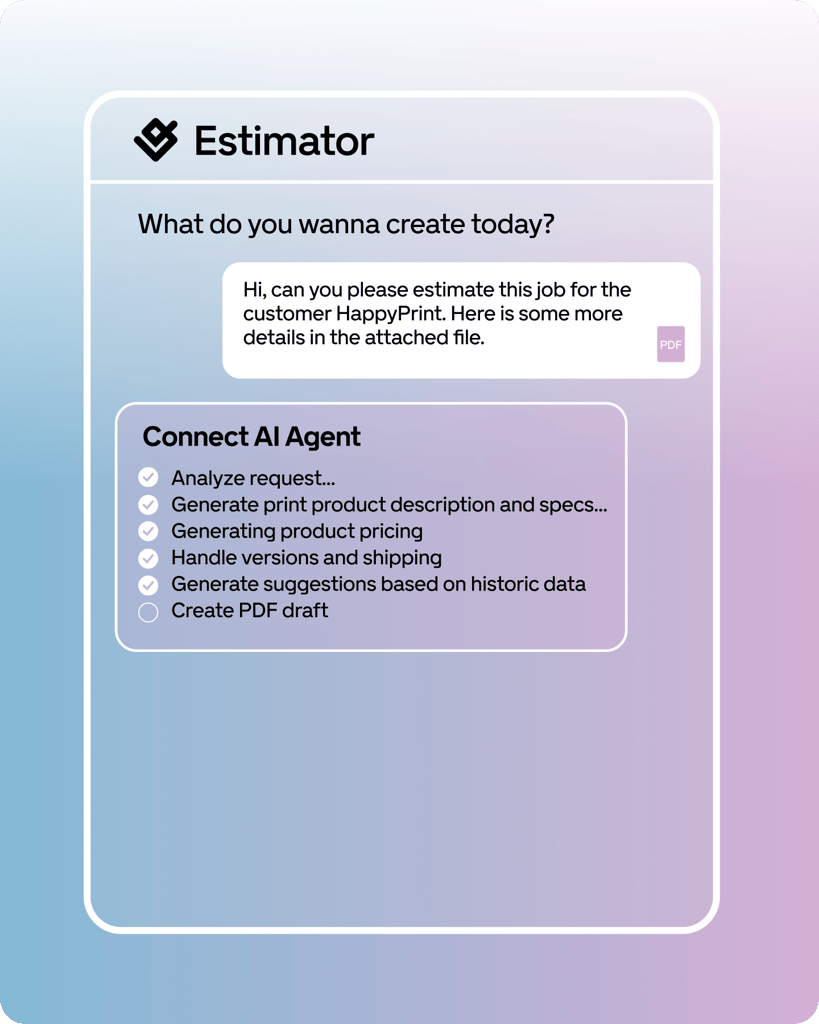
The business case is clear. Calculate your potential ROI from AI estimation to see the specific impact on your operation based on current quote volume, estimator costs, and win rate improvements from faster response. Watch the AI Estimator deminar to understand why fast quoting is now table stakes rather than competitive advantage, and why waiting to adopt AI estimation costs more each month as competitors pull further ahead.
The question isn't whether AI estimation delivers ROI (it does, typically within 3-6 months). The question is whether your operation can afford to compete without it while customers shift to faster, more responsive competitors. 2025 marks the inflection point where AI estimation transitions from early-adopter advantage to operational necessity. Which side of that transition will your operation occupy?
See GelatoConnect Estimator in action
Turn hours of manual quoting into accurate print quotes in seconds. Start your free trial and generate your first AI-powered quote today.
Start your free trial →