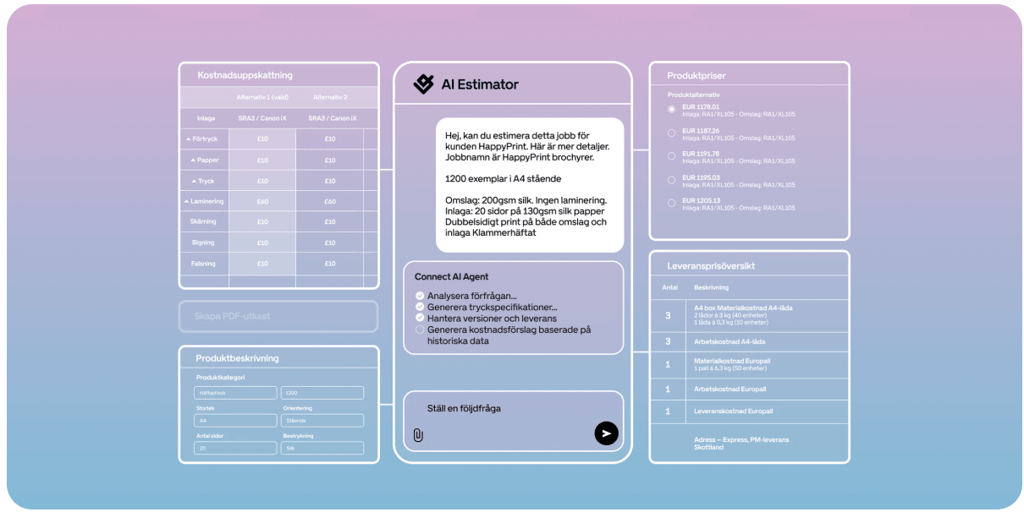
Commercial printing modeling represents the strategic framework through which print businesses analyze operations, forecast performance, optimize resources, and plan for sustainable growth. As the global commercial printing market reaches USD 837.20 billion in 2025 and projects to grow to USD 940.54 billion by 2030 at a compound annual growth rate of 2.38%, understanding effective business modeling becomes essential for competitive success.
Unlike simple financial projections, comprehensive commercial printing modeling encompasses operational capacity analysis, equipment utilization optimization, job costing accuracy, market positioning strategy, and technology investment planning. These interconnected elements form a complete picture of business performance that enables data-driven decision-making in an industry experiencing fundamental transformation.
The commercial printing industry faces unprecedented challenges including declining print runs (average orders have dropped from approximately 3,000 units to under 30 units), rising material and logistics costs, accelerating digital technology adoption, and increasing customer expectations for speed and customization. Successful print service providers navigate these pressures through sophisticated business modeling that balances traditional offset capabilities with digital production, automates workflows to reduce labor intensity, and positions services for emerging market opportunities.
This comprehensive guide explores what commercial printing modeling encompasses, the methodologies print businesses use to optimize operations, how technology enables more accurate modeling and decision support, and the strategic frameworks that distinguish thriving print operations from those struggling to adapt to market evolution.
Understanding Commercial Printing Business Models
Commercial printing businesses operate under various strategic models, each with distinct operational characteristics, target markets, equipment requirements, and profit dynamics. Understanding these fundamental business model variations provides context for the analytical frameworks used to optimize each approach.
Traditional General Commercial Printing
General commercial printers serve broad market segments with diverse product offerings including brochures, catalogs, direct mail, business forms, and marketing collateral. These operations typically maintain both offset lithographic equipment for longer runs and digital production systems for shorter runs and variable data applications.
The business model relies on volume throughput and equipment utilization efficiency. Profit margins in commercial printing average 1-5%, making operational excellence and capacity optimization critical for financial viability. Offset lithography captured 44.1% of global commercial printing market share in 2024 due to its cost effectiveness for high-volume production with consistent quality, though digital printing is expanding rapidly at a 3.45% compound annual growth rate through 2030.
Traditional commercial printers face margin pressure from commodity pricing on standard products and increasing competition from online print aggregators. Success requires either differentiation through specialized capabilities, relationships, and service quality, or achieving scale efficiencies that enable competitive pricing while maintaining acceptable margins.
Quick Print and On-Demand Production
Quick print and on-demand specialists focus on fast turnaround, small quantity orders delivered through storefront locations or web-to-print platforms. These businesses operate primarily digital production equipment that enables economical short runs without the setup costs associated with offset printing.
The on-demand model prioritizes speed and convenience over per-unit cost, attracting customers who value rapid fulfillment and are willing to accept premium pricing for small quantities. Average order values are lower but order frequency is higher compared to traditional commercial printing. Success depends on workflow automation, efficient job scheduling, and streamlined production processes that minimize manual handling.
Digital printing innovations continue transforming this segment. The global digital print market reached $167.5 billion in 2025 and is forecast to grow to $251.1 billion by 2035, representing 54.3% volume growth. This expansion reflects increasing demand for personalization, variable data printing, and short-run production that on-demand specialists are positioned to fulfill.
Packaging and Label Production
Packaging represents the largest and fastest-growing segment of commercial printing, accounting for 44.08% of revenue in 2024. E-commerce expansion drives continuous growth in printed packaging as brands seek distinctive, functional packaging that protects products while communicating brand identity and regulatory information.
Packaging printing utilizes specialized equipment and processes including flexographic, gravure, and increasingly, digital inkjet production. Quality requirements are stringent, as packaging must withstand supply chain handling while meeting food safety and regulatory standards. The business model requires substantial capital investment in specialized presses and finishing equipment, but also commands higher margins than commodity commercial printing.
According to the India Brand Equity Foundation, packaging is currently the fifth-largest sector of the Indian economy, projected to grow at 26.7% compound annual growth rate to reach USD 204.81 billion by 2025. This expansion in emerging markets, combined with sustainable packaging innovations in developed economies, creates substantial opportunities for packaging-focused print operations.
Web-to-Print and Print-on-Demand Services
Web-to-print platforms automate the order-to-production workflow, enabling customers to upload designs, configure specifications, and purchase printing services entirely online. This model eliminates sales overhead while expanding market reach beyond local geographies. Success depends on intuitive web interfaces, robust backend workflow automation, and competitive pricing enabled by operational efficiency.
Print-on-demand extends this model to support retailers and content creators who sell products without inventory risk. Orders flow directly from consumer purchases to production, with fulfillment handled by the print provider. This approach has fueled explosive growth in custom merchandise, personalized gifts, and self-publishing markets.
Modern platforms like GelatoConnect enable print businesses to operate sophisticated web-to-print and production-on-demand services with automated workflow, procurement, and logistics integration. These systems handle everything from order intake through shipping, enabling print providers to scale volume without proportional increases in administrative staff.
 Key Components of Commercial Printing Financial Modeling
Effective financial modeling for commercial printing requires understanding the unique cost structures, revenue dynamics, and operational variables that drive profitability. Comprehensive models incorporate multiple interconnected components that together project business performance.
Equipment Capacity and Utilization Analysis
Equipment represents the largest capital investment for print businesses and drives both capacity and operating costs. Accurate modeling begins with detailed capacity analysis that considers equipment specifications, setup times, run speeds, preventive maintenance schedules, and realistic utilization rates.
Most commercial printers operate below theoretical capacity due to job changeovers, scheduling inefficiencies, and demand variability. Modeling must incorporate realistic utilization assumptions (typically 50-70% for digital presses, 60-80% for offset equipment) rather than nameplate capacity. Small improvements in utilization deliver disproportionate profit impacts due to high fixed costs.
Advanced production planning systems optimize equipment scheduling to maximize utilization while meeting delivery commitments. Print businesses using intelligent scheduling report 15-25% utilization improvements, directly impacting profitability. Financial models should quantify these optimization opportunities to support technology investment decisions.
Material and Supply Chain Optimization
Supply chain modeling should also consider logistics costs, which have increased substantially in recent years. Analysis of 2024 industry data shows 66.5% of print service providers expect tariffs and trade policies to increase costs, with 61.4% forecasting direct margin impacts. Models must incorporate these external factors and evaluate strategies to mitigate cost pressures.
Labor Productivity and Workflow Efficiency
According to industry research, print businesses implementing comprehensive automation report 20-30% labor productivity improvements without quality degradation.
Management Information Systems and Business Intelligence
Integrated print management platforms serve as the operational backbone for data-driven modeling.
The manufacturing operations management software market reached USD 17.46 billion in 2024 and is projected to grow to USD 76.71 billion by 2033 at a 19.1% compound annual growth rate.
Technology Investment and Digital Transformation
According to the latest industry data, 64.4% of print output is expected to be digital by 2026, up from 55.6% today.
 FAQ
FAQ
Q: What is the average profit margin in commercial printing?
A: Commercial printing profit margins typically range from 1-5%... According to recent industry data, print service providers report thin margins that make operational efficiency and capacity optimization critical for profitability.
Q: How do print businesses calculate equipment return on investment?
A: ... Modern print management platforms like GelatoConnect provide detailed equipment utilization and profitability analytics...
Q: What factors are driving changes in commercial printing business models?
A: ... According to 2024 industry research, 75% of print producers report significant revenue shifts toward digital production...
Q: What metrics should print businesses track for effective modeling?
A: ... Integrated print production platforms automatically capture and present these metrics through real-time dashboards...
/GettyImages-1388733856.jpg?width=1024&height=1024&name=GettyImages-1388733856.jpg)