Equipment failures are inevitable in print production. A jammed press, empty ink supply, unexpected maintenance requirement, or technical malfunction can halt operations and cascade into missed deadlines, angry customers, and lost revenue. The average print facility experiences equipment downtime 8-12% of operating hours, translating to 3-5 hours daily of reduced capacity. Traditional facilities scramble to manually reroute jobs, contact customers about delays, redistribute work across remaining equipment, or push operations to costly overtime shifts.
According to KPMG's research on industrial manufacturing, 76% of manufacturing executives express strong willingness to embrace cutting-edge technology, with the highest levels of digital maturity appearing in organizations that leverage real-time data for decision making. GelatoConnect's intelligent workflow system eliminates manual intervention chaos. When a machine goes offline, jobs automatically reroute to available equipment based on capacity, specifications, and delivery requirements. This smart path optimization keeps dispatch rates at 98% on-time even during equipment disruptions.
The difference between struggling operations and thriving facilities isn't whether equipment fails. It's how quickly and effectively they respond when failures occur. Manual coordination takes minutes to hours, during which production stops, deadlines slip, and costs accumulate. Automated routing responds in seconds, maintaining production flow transparently to customers who never know a disruption occurred.
The True Cost of Production Downtime
When a digital press goes down, the visible impact is obvious: the machine stops producing, jobs back up, and delivery timelines compress. But the hidden costs multiply far beyond the stopped machine. Operators scramble to assess which jobs are affected and what their specifications require. Production planners manually redistribute work, checking equipment compatibility, material availability, and staff schedules. Customer service contacts clients about delays, managing expectations and damage control. Expedited shipping absorbs margin to meet original deadlines, turning profitable jobs into break-even or loss situations.
The average print shop runs 4.3 disconnected systems according to industry research, making real-time coordination nearly impossible during equipment failures. Production scheduling lives in one system, inventory management in another, customer orders in a third system, and equipment status tracking in spreadsheets or tribal knowledge. When a press fails, no one has immediate visibility into affected jobs, alternative equipment availability, or optimal redistribution strategies.
GelatoConnect's unified platform provides complete visibility across all equipment, materials, jobs, and schedules in a single integrated system. The platform continuously monitors equipment status through direct integrations or API connections, tracking production capacity, current job loads, maintenance schedules, and performance metrics. This real-time visibility enables intelligent automated response when disruptions occur.
Consider a typical scenario. A large format press experiences a paper jam during a high-priority job with same-day delivery requirements. In traditional operations, an operator notices the jam, attempts to clear it, determines it requires maintenance, notifies the production manager, who checks the job specifications, reviews alternative equipment availability, manually reassigns the job to backup equipment, updates the production schedule, notifies relevant staff, and contacts the customer if delays seem likely. This process takes 15-30 minutes minimum, during which production remains stopped and anxiety increases.
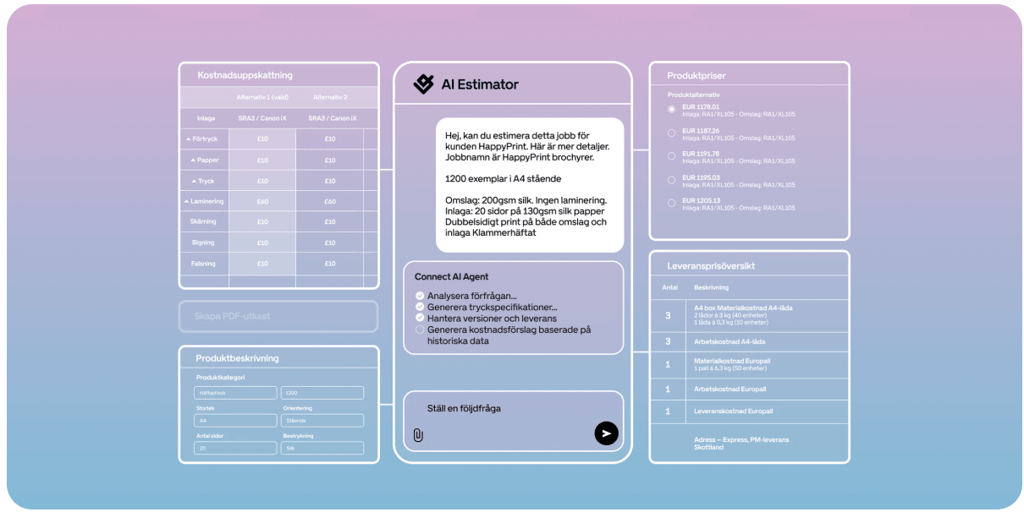
GelatoConnect's intelligent system detects the equipment failure instantly through real-time monitoring. It immediately identifies all affected jobs and analyzes their specifications, priorities, and delivery requirements. The system evaluates alternative equipment, considering substrate compatibility, color profile matching, finishing capabilities, current workload, and delivery timeline requirements. Within seconds, jobs automatically reroute to optimal alternatives, production scheduling updates across all systems, and relevant staff receive notifications about the changes. The entire response completes before an operator would finish attempting to clear the jam manually.
How Smart Routing Maintains Production Flow
GelatoConnect's workflow automation goes beyond simple backup routing to optimize production continuously even without equipment failures. The system analyzes production efficiency across all equipment, identifying underutilized capacity, bottlenecks in job flow, and opportunities to redistribute work for better overall throughput. This proactive optimization means equipment typically operates at 15-25% higher efficiency compared to manual scheduling, with or without disruptions.
When equipment signals maintenance requirements or experiences unexpected downtime, smart routing considers multiple factors simultaneously. Substrate compatibility ensures the backup equipment can handle the specific materials specified in the job. Color profile matching maintains quality consistency when moving jobs between different presses or production lines. Finishing capabilities verify that backup equipment can complete all required post-production steps (cutting, binding, folding, coating). Delivery timeline requirements prioritize urgent jobs for equipment with shortest production queues.
The AI driving these decisions learns from historical performance data. It understands which equipment combinations produce the most consistent results for specific job types. It recognizes patterns in equipment failures, predicting maintenance needs before breakdowns occur. It optimizes material usage by routing jobs to equipment with compatible substrates already loaded, reducing changeover time and material waste. This continuous learning means routing decisions improve over time, becoming more accurate and efficient as the system processes more jobs and analyzes more outcomes.
ESP Colour achieved 20% efficiency gains while maintaining quality standards across production disruptions by implementing this intelligent routing approach. The company reports that equipment downtime no longer triggers the chaos and customer anxiety it once did. Jobs reroute automatically, production continues smoothly, and the team focuses on maintaining quality rather than managing crisis response.
FAQ: Smart Production Routing
Q: Does this require replacing our existing equipment?
No. GelatoConnect integrates with your current presses and finishing equipment through standard interfaces and APIs, adding intelligent routing without hardware changes. The platform works with virtually any production equipment capable of network connectivity or status monitoring.
Q: What happens if multiple machines fail simultaneously?
The system prioritizes jobs based on delivery urgency, customer importance, and margin impact, optimizing available capacity for maximum business value. The platform provides clear visibility into affected orders, enabling proactive customer communication when delays become unavoidable. Even in worst-case scenarios, automated prioritization prevents the complete chaos of manual crisis management.
Q: Can we override automatic routing decisions?
Yes. Operators maintain full control and can manually adjust routing decisions at any time while the system provides data-driven recommendations. This hybrid approach combines automated efficiency with human judgment for complex situations requiring contextual understanding beyond data analysis.
Q: How does the system handle job specifications that only certain equipment can fulfill?
The routing algorithm understands equipment capabilities in detail, never suggesting alternatives that cannot meet job requirements. If no suitable backup equipment exists, the system immediately alerts operators and provides options for customer communication, timeline adjustment, or alternative solutions.
Conclusion
Equipment downtime will always occur. Mechanical systems fail, maintenance schedules must be honored, and unexpected issues arise despite preventive measures. The difference between struggling facilities and thriving operations is how quickly and effectively they respond when failures occur. Manual coordination creates chaos, delays, and customer dissatisfaction. GelatoConnect's smart production paths transform equipment failures from crises into minor operational adjustments that occur transparently without disrupting customer experience.
Research consistently shows that manufacturers are investing heavily in automation and smart technology to mitigate both external and internal operational risks. According to industry studies, technology investment in manufacturing increased 30% year over year as companies recognize that automation reduces vulnerability to disruptions while improving overall efficiency. Smart production routing represents exactly this type of strategic technology investment with immediately measurable returns through maintained delivery commitments and reduced crisis management overhead.
Explore our workflow automation or learn about print production best practices to see how intelligent routing maintains operational excellence regardless of equipment status. The goal isn't preventing failures (impossible) but building resilience that renders failures operationally irrelevant to customer experience and business outcomes.
/GettyImages-1388733856.jpg?width=1024&height=1024&name=GettyImages-1388733856.jpg)